Health insurance
Cheapest health insurance Switzerland 2027 — and what it actually saves.
Basic insurance is identical at every insurer by law. The cheapest 2027 premium in every canton, what the gap really saves, and the levers that save more.
Premium calculator · official BAG tariffs
Your premium for 2027
2027 premiums shown, as published by the Federal Office of Public Health on 29 September 2026.
Zürich · premium region 1 · adult 26+ · (not needed if you're employed 8+ hours a week)
CHF 515
a month at the typical insurer in 2027 — choose yours to see its own premium and change
Cheapest for the same cover
Sumiswalder · CHF 471
The decade behind the price, 2016–2027
A calculator sees the price. It can’t see your supplementary contract, your model’s referral rules or how your insurer pays claims — that’s the review. Free · 45 minutes · In English · With Robert.
Key takeaways
- Swiss basic insurance benefits are identical at every insurer by federal law (Article 25 KVG). In 2027 the cheapest insurer on the Standard model sits CHF 38.50–59.80 per adult per month below the median one in Zürich, Geneva, Basel, Bern, Zug, Lausanne and Lugano.
- Changing model (Standard → family doctor, HMO, Telmed) saves CHF 98.20–147.20 per adult per month at the same insurer in Zürich city — more than picking the cheapest insurer.
- The supplementary tier you choose has the largest financial impact of all three — and it's where most expats over-buy.
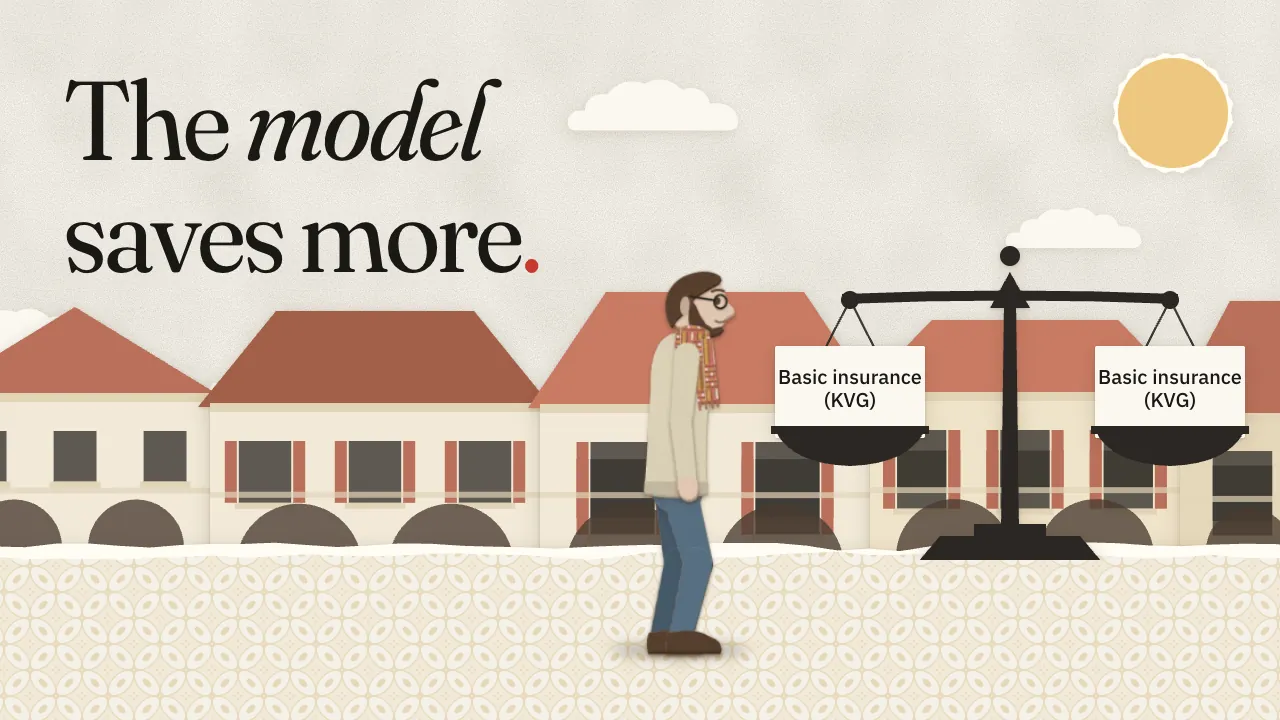
Video · 2:52 Cheapest Swiss health insurance 2027: what it really saves
Video page, chapters and transcript
Chapters
- 0:00Is the cheapest insurer worse?
- 0:15What the cheapest saves
- 0:52The model saves more
- 1:34Can I still see an English-speaking doctor?
- 1:57The bigger number: supplementary
- 2:16Four decisions, in order of weight
- 2:32Your first Swiss insurance review
Read the transcript
0:00 Is the cheapest insurer worse?
What is the cheapest health insurance in Switzerland for 2027? And is the cheapest insurer worse? No. Basic cover is exactly the same at every insurer, by federal law.
0:15 What the cheapest saves
The cheapest adult premium in Switzerland is CHF 227.50 a month, on an HMO model in Zug. But the cheapest insurer saves less than you think, and changing your insurance model saves more. In the seven cities we track, the cheapest insurer costs CHF 38.50 to 59.80 a month less than the median one. Real money, but the smallest of four decisions. And it rarely stays cheapest: in 14 of the 26 cantons, the cheapest is now a different insurer.
0:52 The model saves more
Changing model saves more. At KPT in Zürich, Standard costs CHF 535.60 a month, Telmed 428.50. At seven major insurers there, the cheapest model saves CHF 98.20 to 147.20 a month. The cover stays exactly the same. Only your first point of contact changes. Family doctor: your GP first. HMO: a group practice. Telmed: a phone or video call. So pick the model first, and the insurer second.
1:34 Can I still see an English-speaking doctor?
Can you still see a doctor who speaks English? With Telmed, usually yes: Medgate, behind most major insurers' Telmed lines, consults in English, around the clock. Check your insurer's line first. If you want a doctor in person from the first contact, Standard or the family doctor model remain the right call.
1:57 The bigger number: supplementary
The bigger number is supplementary insurance. It is optional, it varies widely between insurers, and it is where most expats over-buy, often by one or two tiers in their first year. Getting it right usually saves more than the cheapest basic insurer.
2:16 Four decisions, in order of weight
So decide in order of weight: supplementary, model, deductible, and only then the cheapest insurer. Check your figure on priminfo.ch, and cancel by 30 November, for 1 January.
2:32 Your first Swiss insurance review
If you'd like someone to read your own contracts with you, book your first Swiss insurance review. It's free, 45 minutes, in English, with Robert or Nicole. The link is in the description.
The cheapest health insurance in Switzerland for 2027 costs an adult CHF 227.50 a month — Concordia’s HMO model at the CHF 2,500 deductible in Zug, accident included (FOPH premium file, 29 September 2026). On the Standard model, the cheapest insurer sits CHF 38.50–59.80 a month below the median one in Zürich, Geneva, Basel, Bern, Zug, Lausanne and Lugano. What you pay depends on canton, model and deductible.
Most expats arrive in Switzerland looking for the cheapest health insurance. It’s the right question to ask first — and the wrong question to act on. Swiss health insurance at the basic level is identical at every insurer by federal law, the price spread between cheapest and median is marginal, and the financial decision that actually saves you money isn’t the choice of insurer. This post takes the search query seriously — with every approved 2027 premium, published by the Federal Office of Public Health on 29 September 2026 — then redirects it toward the conversation that’s worth having.
Basic is basic, by federal law.
Every Swiss insurer offers exactly the same basic-insurance coverage. Same doctor visits, same hospital care at the general ward in your canton, same medications on the federal list, same maternity care, same legal obligations. The catalogue of benefits is fixed by Article 25 of the Federal Health Insurance Act (KVG) and identical at CSS, Helsana, SWICA, Sanitas, Concordia, Assura, KPT, Visana, Sympany, Atupri, Groupe Mutuel, and every other licensed insurer.
This is the single most important fact about Swiss health insurance that most expats never get told: basic is basic, by federal law, at every insurer. The brochures don’t lead with it because there’s nothing to differentiate. The comparison sites don’t lead with it because their business depends on the comparison feeling consequential.
What changes between insurers is three things: the monthly premium (which varies by canton and age band), the quality of customer service, and which insurance models the insurer offers. The medical coverage itself does not change. If you’re sitting in a hospital in Zürich, the treatment you receive under basic insurance is identical whether you pay CHF 406.80 a month or CHF 750.70 — the cheapest and the dearest adult premium in Zürich city for 2027.
Quick check
So if the medical cover is identical everywhere — what should you actually be comparing in your canton?
What “cheapest” actually saves you.
The premium spread between the cheapest insurer in a city and the median one — half the insurers charge more, half less — is real, but smaller than most expats expect. For an adult on the Standard model with a CHF 2,500 deductible, the cheapest insurer sits CHF 38.50 to CHF 59.80 a month below the median in the seven cities below: CHF 462 to CHF 717.60 a year. The spread between the cheapest and the dearest runs CHF 117.70 to CHF 204.80 a month — bigger, but rarely the comparison anyone actually makes. At the default CHF 300 deductible the franc gaps are the same, to within about a franc.
2027 monthly Standard-model premium, adult (26 and over), CHF 2,500 deductible, accident included, in each city's premium region: the cheapest, the median and the dearest insurer. Source: FOPH (BAG) premium file, 29 September 2026. Premiums without accident cover are lower.
| City | Cheapest insurer | Median insurer | Dearest insurer | Cheapest vs median |
|---|---|---|---|---|
| Zürich (Region 1) | CHF 504.70 — SLKK | CHF 549.75 | CHF 622.40 — Galenos | CHF 45.05/month |
| Geneva | CHF 582.90 — Assura | CHF 642.70 | CHF 787.70 — rhenusana | CHF 59.80/month |
| Basel | CHF 562.10 — SLKK | CHF 605.80 | CHF 726.70 — Philos (Groupe Mutuel) | CHF 43.70/month |
| Bern (Region 1) | CHF 525.40 — Sanitas | CHF 571.45 | CHF 661.30 — rhenusana | CHF 46.05/month |
| Zug | CHF 277.00 — Agrisano | CHF 315.50 | CHF 429.60 — rhenusana | CHF 38.50/month |
| Lausanne (Vaud Region 1) | CHF 533.10 — Galenos | CHF 592.50 | CHF 652.90 — rhenusana | CHF 59.40/month |
| Lugano (Ticino Region 1) | CHF 584.70 — Agrisano | CHF 635.70 | CHF 730.60 — Visana | CHF 51.00/month |
For 2027, the Federal Office of Public Health puts the rise of the mean premium at 5.0% — CHF 412.00 a month across all ages, CHF 487.60 for adults (+4.9%). The cheapest got dearer too: in all 26 cantons, the cheapest adult offer at CHF 2,500 costs more for 2027 than the cheapest did for 2026 — and in 14 of them it now comes from a different insurer. The cheapest insurer rarely stays cheapest.
The point of the table isn’t the exact figure for your neighbour. It’s the order of magnitude. The cheapest-vs-median spread in any major city is real money — but it’s the smallest of the four decisions sitting in front of you.
How much is health insurance in Switzerland? The cheapest offer in every canton, 2027.
If you want the names anyway: the cheapest approved adult premium in each canton, at the maximum and at the default deductible, across every model. In cantons with more than one premium region, the region is noted — it is never Region 1, the region of Zürich, Bern, Lausanne and Lugano; city premiums are higher, as the table above shows. Every one of them is an alternative model: at either deductible, Standard is the cheapest model in no canton.
Cheapest approved 2027 basic premium per canton, adult (26 and over), accident included, any model, per month — at CHF 2,500 and at CHF 300 deductible. Source: FOPH (BAG) premium file, 29 September 2026. The binding figure for your address is on priminfo.ch.
| Canton | Cheapest at CHF 2,500 | Cheapest at CHF 300 |
|---|---|---|
| Aargau | CHF 363.70 — Agrisano, telmed | CHF 474.70 — Agrisano, telmed |
| Appenzell Ausserrhoden | CHF 322.40 — Agrisano, telmed | CHF 433.40 — Agrisano, telmed |
| Appenzell Innerrhoden | CHF 248.40 — KPT, telmed | CHF 376.70 — KPT, telmed |
| Basel-Landschaft | CHF 413.10 — KPT, telmed, Region 2 | CHF 525.00 — Agrisano, telmed, Region 2 |
| Basel-Stadt | CHF 470.70 — Concordia, HMO | CHF 599.00 — Concordia, HMO |
| Bern | CHF 357.20 — Agrisano, telmed, Region 3 | CHF 468.10 — Agrisano, telmed, Region 3 |
| Fribourg | CHF 353.80 — KPT, telmed, Region 2 | CHF 479.50 — Aquilana, telmed, Region 2 |
| Geneva | CHF 483.40 — Assura, family doctor | CHF 611.70 — Assura, family doctor |
| Glarus | CHF 327.50 — KPT, telmed | CHF 453.10 — Agrisano, telmed |
| Graubünden | CHF 304.60 — vita surselva, family doctor, Region 3 | CHF 421.80 — Agrisano, telmed, Region 3 |
| Jura | CHF 456.00 — Sanitas, telmed | CHF 584.30 — Sanitas, telmed |
| Lucerne | CHF 312.20 — Luzerner Hinterland, telmed, Region 3 | CHF 439.70 — Agrisano, telmed, Region 3 |
| Neuchâtel | CHF 465.40 — Sanitas, telmed | CHF 583.40 — Agrisano, telmed |
| Nidwalden | CHF 286.75 — Sanitas, telmed | CHF 399.20 — Agrisano, telmed |
| Obwalden | CHF 299.00 — Agrisano (telmed) and Concordia (HMO) | CHF 410.00 — Agrisano, telmed |
| Schaffhausen | CHF 334.10 — Agrisano, telmed, Region 2 | CHF 445.00 — Agrisano, telmed, Region 2 |
| Schwyz | CHF 316.20 — Concordia, HMO | CHF 434.70 — Agrisano, telmed |
| Solothurn | CHF 392.80 — Agrisano, telmed | CHF 503.80 — Agrisano, telmed |
| St. Gallen | CHF 311.10 — Agrisano, telmed, Region 3 | CHF 422.10 — Agrisano, telmed, Region 3 |
| Thurgau | CHF 336.50 — Atupri, HMO | CHF 453.80 — Agrisano, telmed |
| Ticino | CHF 457.75 — Sanitas, family doctor, Region 2 | CHF 569.20 — Agrisano, telmed, Region 2 |
| Uri | CHF 282.30 — Atupri, HMO | CHF 401.50 — Agrisano, telmed |
| Valais | CHF 317.90 — sodalis, telmed, Region 2 | CHF 429.00 — Agrisano, telmed, Region 2 |
| Vaud | CHF 431.10 — Philos (Groupe Mutuel), telmed, Region 2 | CHF 559.10 — Philos (Groupe Mutuel), telmed, Region 2 |
| Zug | CHF 227.50 — Concordia, HMO | CHF 350.60 — Agrisano, telmed |
| Zürich | CHF 338.90 — SLKK, telmed, Region 3 | CHF 456.80 — SLKK, telmed, Region 3 |
A cheapest offer is a model with rules — a telmed line to call first, a family doctor or an HMO clinic as your gatekeeper — and it is only cheap if those rules fit how you use healthcare. That’s the next section.
Quick check
Want us to look at where you're actually paying for what you don't need?
Where the real money lives.
The cheapest-insurer choice is one of four decisions that determine what you pay for Swiss health insurance. The other three each carry a larger financial weight. Most expats spend an evening comparing insurers and zero hours on the three decisions that matter more.
Model choice saves more than insurer choice.
Standard means free choice of doctor — the most expensive model because it’s the most flexible. Every alternative routes your first medical contact through a specific channel (your GP, an HMO clinic, a telmed line) in exchange for a discount on the Standard premium. In Zürich city for 2027, moving from Standard to the same insurer’s cheapest alternative model saves CHF 98.20 to CHF 147.20 per adult per month at the CHF 2,500 deductible — more than the spread between the cheapest and the median insurer on Standard (CHF 45.05).
Same insurer, same canton, same coverage by federal law. Different first point of contact. Larger saving than the cheapest-insurer choice. We cover the model decision in detail in Swiss health insurance models explained.
The pattern holds across the major insurers. Below is the 2027 monthly premium for Zürich Region 1, adult on the CHF 2,500 deductible, by model — the francs move significantly within each insurer when you change model, and far less when you change insurer at the same model.
2027 Zürich Region 1 monthly premium by insurer × model, adult (26 and over), CHF 2,500 deductible, accident included. — = the insurer files no tariff of that model for the region. Source: FOPH (BAG) premium file, 29 September 2026.
| Insurer | Standard | Family doctor | HMO | Telmed |
|---|---|---|---|---|
| Atupri | CHF 516.00 | CHF 445.10 | CHF 406.80 | CHF 433.50 |
| Assura | CHF 527.90 | CHF 413.10 | — | CHF 429.50 |
| CSS | CHF 589.70 | CHF 442.50 | — | CHF 529.10 |
| Sanitas | CHF 515.50 | CHF 431.80 | CHF 457.55 | CHF 412.50 |
| Helsana | CHF 547.70 | CHF 432.70 | — | CHF 453.00 |
| SWICA | CHF 563.80 | CHF 451.40 | CHF 454.80 | CHF 510.20 |
| Sympany | CHF 526.70 | CHF 448.10 | CHF 428.50 | CHF 428.50 |
Within each of these seven insurers, Standard to its cheapest alternative model saves CHF 98.20 (Sympany) to CHF 147.20 (CSS) a month. Between them, on Standard, the whole spread is CHF 74.20 — Sanitas at CHF 515.50 to CSS at CHF 589.70. And which model is cheapest differs by insurer: the family-doctor model at Assura, CSS, Helsana and SWICA, HMO at Atupri, Telmed at Sanitas. Pick the model first; pick the insurer second.
Model impact on a single canton — Zürich Region 1 worked example.
The four model choices on the same insurer, same canton, same Franchise — what each model actually trades for the discount, and which household profile each fits. The insurer here is KPT.
Zürich Region 1, 2027, adult on the CHF 2,500 deductible, accident included — KPT across all four rows. Premiums: FOPH (BAG) premium file, 29 September 2026. The trade-offs are the architectural reality.
| Model | Premium | Trade-off | Right for whom |
|---|---|---|---|
| Standard | CHF 535.60/mo | None — full freedom of doctor choice | Households who already have specific GPs and specialists they trust, value freedom over savings |
| Family doctor (GP first) | CHF 444.50/mo | Must register a GP from insurer’s network; GP is gatekeeper for specialist referrals | Households comfortable with a single primary-care relationship; saves CHF 91.10/month vs Standard |
| HMO (clinic first) | CHF 433.80/mo | First contact is an insurer-approved clinic, not a private practice | Urban households near an HMO clinic who don’t need a personal GP relationship |
| Telmed (call first) | CHF 428.50/mo | First contact is a telemedicine call before any in-person visit | Younger, healthier households comfortable with phone-first triage; KPT’s biggest discount |
The CHF 107.10/month spread between Standard and Telmed at the same insurer in the same city is real money — CHF 1,285.20 per year. The discount is paid for in the form of a workflow constraint, not a coverage cut. The federal benefits catalogue (Art. 25 KVG) is identical across all four rows.
Deductible choice flips the math.
The Franchise — your annual deductible — is set by Article 64 KVG at CHF 300 (default) up to CHF 2,500 (maximum) for adults, with intermediate options at CHF 500, 1,000, 1,500, and 2,000. Children’s deductibles run from CHF 0 to CHF 600. Above the franchise, the Selbstbehalt (copay) is 10% of costs, capped at CHF 700 per adult per year and CHF 350 per child.
Choosing the maximum CHF 2,500 deductible lowers the premium by CHF 127.25 a month at the median Zürich-city insurer on the Standard model (CHF 677.00 → CHF 549.75) — close to the legal maximum discount of 70% of the extra CHF 2,200 of risk (Art. 95 KVV). Whether that’s the right call depends on your actual healthcare usage — not on whether you want a “cheap” plan. If you’re young, healthy, and rarely see a doctor, the maximum deductible saves you CHF 1,527 a year there. If you have a single CHF 4,000 procedure in the year, the high deductible costs you CHF 1,980 more out of pocket than the default would — more than it saved.
Supplementary is where most money is overspent.
This is the one we see most often in the first consultation. Supplementary insurance — hospital, dental, alternative medicine, abroad coverage — is voluntary, varies wildly between insurers, and is where most expats over-buy in their first year by one or two tiers above what their actual usage justifies. The annual saving from right-sizing supplementary typically exceeds the saving from switching to the cheapest basic insurer by a multiple, not a margin.
Most expats who diligently switch basic insurer every November to capture CHF 30/month never review the CHF 100–200/month supplementary product they bought from a sales agent in their first month in Switzerland. The cheapest-basic optimisation is satisfying because it’s measurable and visible. The right-sized-supplementary optimisation is harder, but it’s where the actual money lives.
The four decisions, in order of financial impact.
If you flip the order most expats follow — insurer first, then maybe model, then maybe deductible, then never supplementary — into the order that matches the actual financial weight, the conversation changes.
-
Right-size your supplementary.
The largest financial lever. Most expats over-buy in year one and don't review. Reviewing typically saves CHF 50–200 per adult per month — more than every other decision combined. The catch: supplementary requires health questions, so changes are easier the earlier you make them.
-
Pick the right insurance model.
Standard vs family doctor vs HMO vs Telmed. In Zürich city for 2027 it saves CHF 98.20–147.20 per adult per month at the same insurer for the same coverage. The right model depends on how you actually use healthcare — not on which model has the deepest discount.
-
Choose the appropriate deductible.
At the median Zürich-city insurer, CHF 2,500 costs CHF 127.25 a month less than the default CHF 300 — but only fits if you rarely use healthcare. The wrong deductible costs you back the saving in a single claim year. Pick the deductible that matches your typical year, not the one that minimises the premium on paper.
-
Then — and only then — pick the cheapest insurer.
The final filter. In 2027 the cheapest Standard-model insurer sits CHF 38.50–59.80 a month below the median one in the seven cities above, for the same age band, model and deductible. Real money — but the smallest of the four decisions. Run your postcode through our premium calculator each November and switch if the gap is meaningful.
Premium subsidies — a real lever for some expats.
Prämienverbilligung is the cantonal premium-subsidy system for residents whose income falls below thresholds set individually by each canton. The thresholds, application process, and subsidy amounts vary cantonally — Vaud and Geneva have generous schemes that catch mid-income expats, while some German-speaking cantons have tighter thresholds. Worth applying for in any case: the subsidy can run to several hundred francs a month per adult in the cantons that subsidise generously.
For most professionally-employed expats, the subsidy doesn’t apply — incomes are above the threshold. For freelancers, parental-leave situations, or households with one parent reducing hours after a child, the subsidy can become the largest single lever on premium cost, larger than any of the four decisions above. We have a step-by-step on how to apply at how to apply for premium subsidies.
The four traps in optimising for cheap.
trap 01
The age-curve trap.
Some supplementary plans are cheap at 32 and brutal at 55. We model the 20-year cost, not the signup price.
trap 02
The 3-month deadline.
New residents must register for basic insurance within 3 months or face penalty surcharges and canton-assigned coverage.
trap 03
Coverage that pays vs. coverage that fights.
Every insurer's brochure looks generous. The real question is which ones actually approve claims.
trap 04
We match coverage to your life.
We check actual needs and recommend only what fits, even if that means fewer products than expected.
The longer reference on each trap — federal-law foundation, the typical misunderstanding, the cost, what we do — sits in the four-traps deep dive.
These four traps map directly to the cheapest-is-best premise. The age-curve trap is buying cheap supplementary at 32 because the premium is low — and watching it become expensive at 55 when you can no longer easily switch out. The three-month deadline matters because new arrivals who don’t register on time get assigned a default insurer at the standard premium, which is rarely the cheapest — the full first-90-days sequence sits at our newcomer landing page. Coverage-that-pays is the difference between a cheap basic premium that genuinely covers the same things and a cheap supplementary product that fights every claim. And matching coverage to your life is the honest version of the cheapest-insurer question — the right insurance isn’t the cheapest, it’s the one that fits how you actually use healthcare.
When the cheapest IS the right answer.
For most expats, the cheapest basic insurer in their canton is a perfectly fine choice — there’s no real downside, since basic coverage is identical by federal law everywhere. We tell clients this honestly: if you’ve already got the right model, the right deductible, and right-sized supplementary, picking the cheapest basic insurer in your canton each November is a sensible thirty-minute task.
The mistake isn’t picking the cheapest. The mistake is acting as though picking the cheapest is the financial decision, when it’s the smallest of four. We see clients who have switched insurer five times in seven years to capture CHF 30 a month, and never once reviewed the CHF 1,800-a-year supplementary product they don’t use.
The honest answer.
Pricing a whole family? The children’s rules and the household cap are in family health insurance in Switzerland. Ready to act? Switch before 30 November.
The decisions in front of you, in order of financial weight: the supplementary tier, the insurance model, the deductible, then the insurer. If you’ve optimised the first three, the fourth becomes a thirty-minute task at the end of November — run your postcode through our premium calculator, check the cheapest option at your age and deductible, confirm the binding figure on priminfo.ch, send the registered letter by 30 November, switch on 1 January.
If you’ve only optimised the fourth — the cheapest insurer — the first three are still costing you money. The conversation worth having isn’t which insurer is cheapest. It’s which combination of supplementary tier, model, deductible, and insurer fits how you actually use healthcare. That’s the conversation we have in the first consultation, and it’s the one this post exists to redirect you toward.
Frequently asked.
What is the cheapest health insurance in Switzerland for 2027?
Are all Swiss basic health insurance plans the same?
How much is health insurance in Switzerland in 2027?
What's the difference between Franchise and Selbstbehalt?
Can I switch to the cheapest insurer every year?
Should I always pick the cheapest insurance plan?
What is Prämienverbilligung?
By the team