
Switching Swiss health insurance — when it actually makes sense.
Basic insurance is usually safe to compare every year. Supplementary insurance is where people make expensive mistakes.
Cancellation must arrive by 30 November for 1 January.
Supplementary (VVG)
30 Sept 2026
Many contracts need three months' notice to year-end — before the new premiums are even published. Terms differ per contract: check yours. Never cancel before the new insurer's written acceptance.
Basic (KVG)
30 Nov 2026
Cancel once you've seen the new tariffs — the letter must arrive by this date. Acceptance at the new insurer is mandatory, and the law allows no coverage gap.


45 minutes with Robert. Free.
In English · With or
We'll send you a short intake form so we understand your needs before we speak.
Your details
You're booked
Check your email for a calendar invite and a video call link.
Can you switch Swiss health insurance?
Basic insurance
Usually safe to switch.
Basic benefits are identical by federal law. Every Swiss basic insurer must accept you, so the decision is mostly premium, model, Franchise, and administration.
Supplementary insurance
Do not switch blindly.
Supplementary is underwritten again. A new insurer can exclude, surcharge, or decline conditions that developed after your original contract.
Deadline
The annual date is 30 November.
The cancellation must arrive by 30 November. Postmark is not enough. Registered mail is the clean proof.
I want to switch health insurance — which one should I choose?
Basic cover is the same everywhere: benefits are identical by law (Art. 25 KVG) and every insurer must accept you (Art. 5 KVAG). For basic, choose on the premium for your postcode, age, model and deductible, then on service. On savings: in the median Swiss premium region, the cheapest standard-model offer is CHF 50.40 a month below the median offer (FOPH 2027 premiums, our analysis), and CHF 66.19 across all models. Supplementary is a different decision: a new insurer asks new health questions (Art. 4 VVG) and can exclude anything that has come up since you signed, so do not cancel it before you hold a written acceptance. Here is how the 11 insurers compare on service.
Premium calculator · official BAG tariffs
Your premium for 2027
2027 premiums shown, as published by the Federal Office of Public Health on 29 September 2026.
Zürich · premium region 1 · adult 26+ · (not needed if you're employed 8+ hours a week)
CHF 515
a month at the typical insurer in 2027 — choose yours to see its own premium and change
Cheapest for the same cover
Sumiswalder · CHF 471
The decade behind the price, 2016–2027
A calculator sees the price. It can’t see your supplementary contract, your model’s referral rules or how your insurer pays claims — that’s the review. Free · 45 minutes · In English · With Robert.

The deadline path is simple when the order is right.
For basic insurance the order is forgiving: register with the new insurer and cancel the old one — acceptance is mandatory (Art. 5 KVAG) and the law allows no gap (Art. 7 Abs. 5). Only supplementary demands patience: written acceptance first, always.
- 01
By end of October
Your 2027 premium letter arrives
Insurers notify the new premium by the end of October (ch.ch); the federal average is public from 29 September.
- 02
October
Compare
Use priminfo.ch for the price grid. Then check Franchise, model, insurer, and split.
- 03
Early November
Register
Register with the new basic insurer and send your cancellation — acceptance is mandatory (Art. 5 KVAG), so for basic cover there is nothing to wait for. Only supplementary needs written acceptance before anything is touched.
- 04
Mid November
Send
Send the cancellation by registered post — by 25 November at the latest, earlier if you can. Read what the cancellation letter must contain.
- 05
30 November
Arrive
Cancellation must arrive by this date, not merely be postmarked.
- 06
1 January
Start
New basic coverage begins. Art. 7 Abs. 5 KVG allows no gap: the old cover only ends once the new insurer confirms to the old one.
For the full procedural detail — letter template, registered-mail rule, the mid-year cancellation rights under Art. 7 KVG — see our cancellation-deadline reference. Or have it run for you: we draft and send the cancellation for clients — the review is free.
How to cancel Swiss basic insurance in time.
-
Apply to the new insurer first
For basic cover, acceptance is mandatory (Art. 5 KVAG), so the application is a formality — but it comes before the letter.
-
Send the cancellation so it arrives by 30 November
Registered post, so the receipt proves the day it arrived. If 30 November falls on a weekend, it must arrive on the last working day before (ch.ch).
-
The old cover ends when the new insurer confirms
The old cover ends only once the new insurer confirms your new cover to the old one (Art. 7 Abs. 5 KVG), so no gap can occur.
Letter template, registered-mail rule and the mid-year rights: cancel Swiss health insurance in writing.
When to switch, when to pause.
Most people ask whether they can switch. The better question is which contract can move safely. Basic and supplementary need different answers.
| Trigger | First check | Basic insurance | Supplementary insurance |
|---|---|---|---|
| Premium jumped in September | Compare basic insurance, model, and Franchise | Usually yes, if the same coverage path is cheaper | Only after underwriting review |
| Claim was not paid or service got painful | Check whether the issue is basic administration or supplementary contract behaviour | Often worth comparing | Depends on health history and exclusions |
| Moved canton | Run the canton × age × model grid again | Often yes, because premiums are cantonal | Usually keep until accepted elsewhere |
| GP, HMO, or Telmed no longer fits | Change model before changing insurer blindly | Sometimes the model switch is enough | Separate decision |
| Planning treatment or pregnancy | Read supplementary contract first | Basic can still move if timing is clean | Usually do not switch without advice |
| Premium letter rises less than the canton average | Model and deductible first, before the insurer | Usually stay | Separate decision |
| New to Switzerland | Use the first 90-day setup process instead | Different deadline logic | Different underwriting window |
Table logic for the review: basic can usually move; supplementary is read before it is touched. The usual triggers: the autumn premium letter · a canton move · a model that no longer fits · the wrong Franchise · painful service · arriving in Switzerland (a different deadline entirely). Canton averages: 2027 premiums in your canton.
Two contracts. Two different decisions.
The most common switching mistake is treating basic and supplementary as one product. They are governed by different statutes and create different risks. Pick your contract:
Compare yearly. Switch when the maths works.
Every Swiss basic insurer covers the same federally-defined catalogue of medical care under Art. 25 KVG. Acceptance is mandatory under Art. 5 KVAG. Switching changes the premium and model, not the medical benefits.
The conditions to change
- Every year: cancellation arriving by 30 November, cover changes 1 January
- Mid-year: with the standard CHF 300 franchise and standard model, cancel for end of June — notice arriving by 31 March (Art. 7 Abs. 1 KVG)
- On a premium change: the extraordinary right — cancel by the end of the month before the new premium applies (Art. 7 Abs. 2 KVG)
- No underwriting, no health questions, no risk to coverage
It depends on your health.
Supplementary switching triggers fresh underwriting under Art. 4 VVG. If you have any flagged history, the new insurer can exclude, surcharge, or decline the coverage you were trying to improve.
The conditions to change
- Written acceptance first, always — never cancel before the new insurer has accepted you in writing
- Notice periods are contract-specific — many run three months to year-end (cancellation by 30 September), some carry multi-year terms. For many supplementary contracts the notice date for 1 January is 30 September — check your contract (AVB) before you plan a move. Whether it is worth keeping at all: supplementary health insurance, worth it or not.
- Healthy, no flagged history? Shop the market — insurers bring new products every year
- Past surgery, ongoing medication, chronic condition, mental-health treatment, pregnancy, or a planned procedure? Usually stay
Bring the policy. We separate the contracts.
Many expats do not know which line is basic, which line is supplementary, and which line is just an optional model. That is normal. We read the current policy first and label the decision before recommending anything.
- We identify basic, supplementary outpatient, hospital, and accident cover
- We check which parts can be moved safely — and flag anything that should be left untouched
- You leave with your Private Client Report — the clean path, in writing
Book your first Swiss insurance review·What the report contains
Basic switching is harmless and often worth running. Supplementary switching is one of the easiest ways to lose coverage you'll need later. The two decisions deserve different conversations.
What your 2027 premium letter means.
Federal average
CHF 412 a month, +5.0%
The official average premium for 2027, all ages (FOPH, published 29 September 2026).
Your canton
Adult averages move differently
Zürich +5.7% · Bern +5.0% · Basel-Stadt +4.5% · Zug +4.4% · Geneva +4.3% · Vaud +3.2%
What to do
Compare when yours rises more
If your own letter rises clearly more than your canton's average, compare. If it rises less, look at model and deductible before changing insurer: the five levers that lower your premium.
We read the contract before we compare prices.
The review is not a sales call. It is a structured read of what can move safely, what should stay, and what is actually worth changing — and it ends in writing.
-
We read the policy first
Basic, supplementary outpatient, hospital, accident coverage, model, Franchise, and bundled discounts — identified before recommending anything.
-
We separate the decisions
Basic insurance is a price and model decision. Supplementary insurance is a health-history and contract-quality decision.
-
We run the four levers
Franchise, model, insurer, and basic/supplementary split. The cheapest insurer is often not the biggest lever.
-
You get it in writing: switch, stay, or restructure
Within 3 working days, your Private Client Report — the reasoning, the risk flags, the timing, and the next administrative step. All three answers are normal.
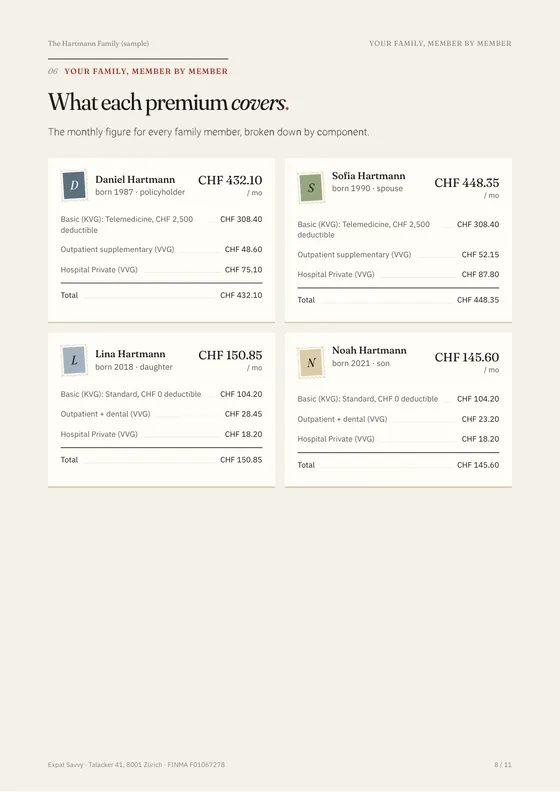
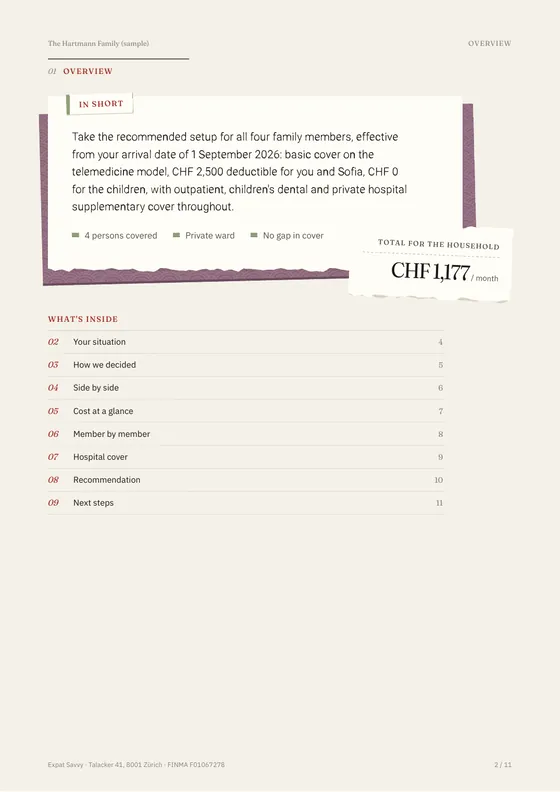
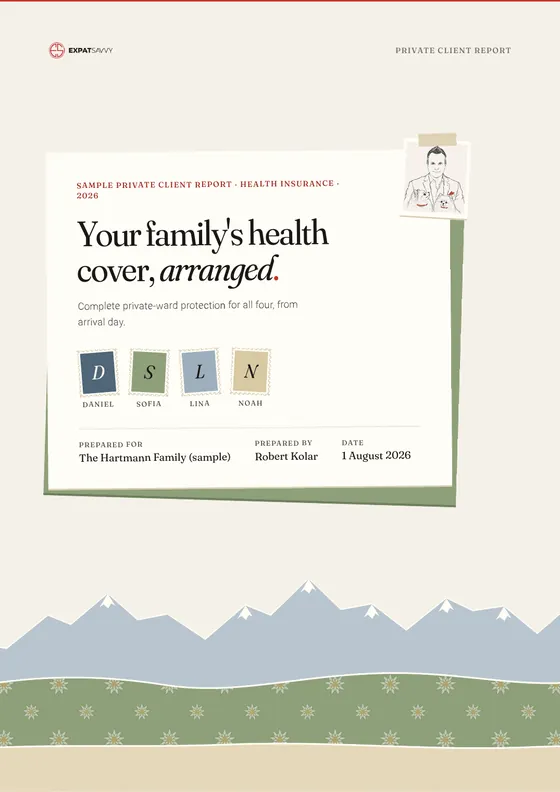
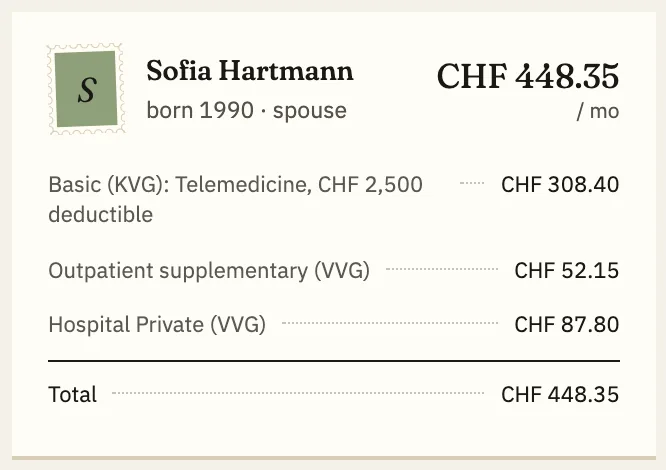
Read the full sample · Download the PDF · What's inside
05 · What the review checks
The four levers before we say switch, stay, or restructure.
Switching insurer is the most visible lever and often not the strongest one. Franchise, model, and keeping supplementary untouched can matter more.
Franchise — the deductible
The biggest immediate basic-insurance lever. Six legal adult tiers: 300, 500, 1,000, 1,500, 2,000, 2,500. The right tier depends on actual care usage, not optimism.
What we check
- Your care usage in the last 12–24 months
- Whether you can absorb the higher out-of-pocket year
- The premium discount at your canton × age × model
We usually find the Franchise answer before we even compare insurers.
Read the Franchise reframeModel — Standard, GP, HMO, Telmed
Model can move 15–20% of basic premium with the same insurer. It is often upstream of the insurer decision, because model availability varies by canton and network.
What we check
- Whether your existing doctor sits in the network
- How much gatekeeping you actually tolerate
- Whether model savings beat insurer-only switching
For many settled expats, the model switch saves more than the insurer switch.
Swiss health insurance models explainedInsurer — the headline switch
On basic insurance, federal benefits are identical. Insurer competition sits in premium, administration, model availability, and service reputation. On supplementary, insurer choice is much more consequential.
What we check
- Your canton-by-canton premium grid
- Claim-handling reputation and administration quality
- Whether the cheaper insurer creates a worse practical experience
Switching insurer alone is rarely the whole answer. It is one lever, not the architecture.
Split basic and supplementary
Basic and supplementary do not have to sit with the same insurer. This is one of the most useful levers and one of the least explained by sales calls.
What we check
- Whether your supplementary contract is still worth keeping
- Whether basic can move without disturbing supplementary
- Whether the bundled discount is real or just convenient
A common recommendation: move basic if the maths works, keep supplementary where it is.
Cancellation-deadline reference06 · Worked example
The better answer was not just switching insurer.
A Zürich household received a premium notice raising basic from CHF 432 to CHF 478 per month, each. Their first instinct was to switch provider immediately.
Premium notice
CHF 432 → CHF 478 each
The increase was real, but the insurer was only one lever.
Review the whole basic setupFranchise
CHF 300 tier
Actual care usage made CHF 1,500 the better fit.
Save CHF 64/month eachModel
Standard model
Their existing GP was already inside the Hausarzt network.
Save CHF 38/month eachInsurer
Current provider
A cheaper Zürich provider added a useful but smaller saving.
Save CHF 22/month eachSupplementary
Tempting to switch
The outpatient contract was working. A new application would reopen underwriting.
Keep it untouchedOutcome
CHF 124saved /month per person
CHF 2,976/year for the household — switching insurer alone would have saved CHF 528. Illustrative, anonymized; Zürich tariffs.
Book your first Swiss insurance review07 · Portals vs advice
Priminfo compares prices. We read the contract.
If you only want the cheapest basic premium, priminfo.ch or an app like primai.ch is the right tool. Our work starts when the question is bigger than price: basic insurance, supplementary contracts, Franchise, model, insurer behavior, age curve, and whether staying is safer.
The federal-law foundation
The Swiss switching framework rests on Art. 7 KVG for the 30 November cancellation deadline, Art. 25 KVG for identical basic benefits, Art. 5 KVAG for mandatory acceptance, and Art. 4 VVG for supplementary disclosure obligations.
What about loyalty discounts?
There are no loyalty discounts on Swiss basic insurance. On supplementary, group, family, and multi-year discounts can exist, but each needs to be checked against the contract and the flexibility you give up.
Does switching every year hurt my standing?
On basic, no. Every basic insurer must accept every Swiss resident. On supplementary, yes, every new application can reopen underwriting and exclusions.
What clients say
★★★★★
I highly recommend this office for all types of insurance. After having several bad experiences with other brokers, working with Mr. Robert Kolar was a completely different experience. He is incredibly professional, friendly, and solved my complex insurance problems in a timely manner. What I appreciated most was that he took all the time needed to make sure I truly understood my policies.
★★★★★
I had an excellent experience working with Robert. I was looking to change providers for one of my supplementary insurance plans, and he guided me through the process with professionalism, patience, and expertise. Thanks to his guidance, I was able to secure a policy that perfectly suits my needs.
★★★★★
I was a bit lost with all the administrative procedures after moving to Switzerland, especially regarding my health insurance situation. Nicole took the time to understand my case and explain everything very clearly. She answered all my questions, explained the legal aspects and gave me practical advice on how to move forward. What I appreciated the most is that she was trying to help me solve my problem, not simply sell me an insurance policy.
★★★★★
My session with Robert — without a doubt — was one of the most efficient consultation sessions I'd ever had. He is honest, straightforward and transparent from the outset. He knows the insurance industry inside out. He helped me with my situation without any reservation. You confide to him within minutes into the session and take his honest and unbiased advice.
See more reviews
★★★★★
Robert is the best person to partner with if you need to do difficult things such as relocate and navigate the complications of healthcare insurance in Switzerland. Robert went beyond what was expected and in a very caring way making sure that we had a really good arrival in Switzerland.
★★★★★
Extremely helpful and knowledgeable consultation in all facets of current health insurance offerings. Highly recommend consulting Expat Savvy before making any online insurance comparisons.
★★★★★
I had an excellent experience working with Nicole Bohne. She assisted and guided me through the entire process of obtaining my Swiss pension refund, making what could have been a complicated process incredibly straightforward and stress-free. Nicole was always friendly, professional, knowledgeable, and extremely efficient. She kept me informed every step of the way, answered all my questions promptly, and ensured everything was handled smoothly from start to finish. I highly recommend Nicole and her company to anyone needing assistance with Swiss pension refunds or related services.
★★★★★
After returning to Switzerland from abroad, Robert from Expat Savvy was a tremendous help consulting me about all the changes. He took the time to show me several options and definitely went the extra mile compared to other agents.
★★★★★
Working with Ben was great. Very prompt and responsive. Would highly recommend to anyone!
★★★★★
Benjamin überzeugt durch seine hervorragende Organisation und klare Kommunikation, Robert durch seine kompetente und ehrliche Beratung. Beide arbeiten Hand in Hand und haben die individuellen Anforderungen unserer Kunden immer im Blick — absolut empfehlenswert!
FAQ.
Is it worth comparing Swiss basic insurance every year?
Should I switch supplementary insurance to save money?
When is the deadline to switch Swiss health insurance?
Can I switch Swiss basic insurance mid-year?
Does switching basic insurance change my coverage benefits?
Can I have basic and supplementary insurance with different companies?
How long does the Swiss health insurance switching process take?
Can I switch my basic and supplementary insurance at the same time?
What's the average Swiss health insurance premium increase per year?
Does switching basic insurance affect my claims history?
Can I cancel mid-year if I move cantons?
Is it worth using a comparison portal like priminfo.ch?
Which health insurance should I switch to in Switzerland?
How much can I save by switching health insurance for 2027?
Can I cancel my health insurance by email?
When will I get my 2027 premium letter?
Do you only compare Swiss health insurance premiums?
Compare yearly. Stay smart on supplementary. Book the review.
The 45-minute review is free. We compare your basic insurance against the canton × age × model grid, read your supplementary contract, and tell you which path is yours: switch, stay, or restructure. Most reviews end with a one-page written summary inside three working days. No first-call contracts. No pressure.
Book your first Swiss insurance review