
Health insurance for foreigners in Switzerland — the whole setup, done right.
New residents usually have three months — and enrolled on time, cover and premiums run from your registration date, so waiting saves nothing. The real work is the sequence: accident cover, franchise, model, and whether supplementary is applied for now or left alone.
Three months from registering with your commune.







45 minutes with Robert. Free.
In English · With or
We'll send you a short intake form so we understand your needs before we speak.
Your details
You're booked
Check your email for a calendar invite and a video call link.
New to Switzerland: what has to happen first?
Every foreigner who comes to live in Switzerland must take out Swiss basic health insurance within three months of registering with the commune (Art. 3 KVG). Every insurer must accept you, whatever your health, and the benefits are identical at all of them (Art. 25 KVG). Enrol within the three months and cover — and premiums — run from your registration date. What differs is the price by canton, model and deductible, and the optional supplementary layer.
Deadline
You usually have 3 months.
Swiss basic health insurance is mandatory for residents. The federal rule for foreign nationals is three months after registering with your commune. In practice, bring your registration paperwork and we verify the exact canton timeline.
Enrolled on time, coverage — and premiums — run from your registration date. Waiting saves nothing.
First move
Set up basic before optimising.
Basic insurance gets you compliant. After that, the real choices are franchise, model, accident coverage, family setup, and whether supplementary makes sense.
Supplementary
Review it early — honestly.
Supplementary insurance is medically underwritten. Future health events can affect acceptance, so we check early whether it is worth applying now or skipping — and every health question gets answered fully, including treatment abroad.

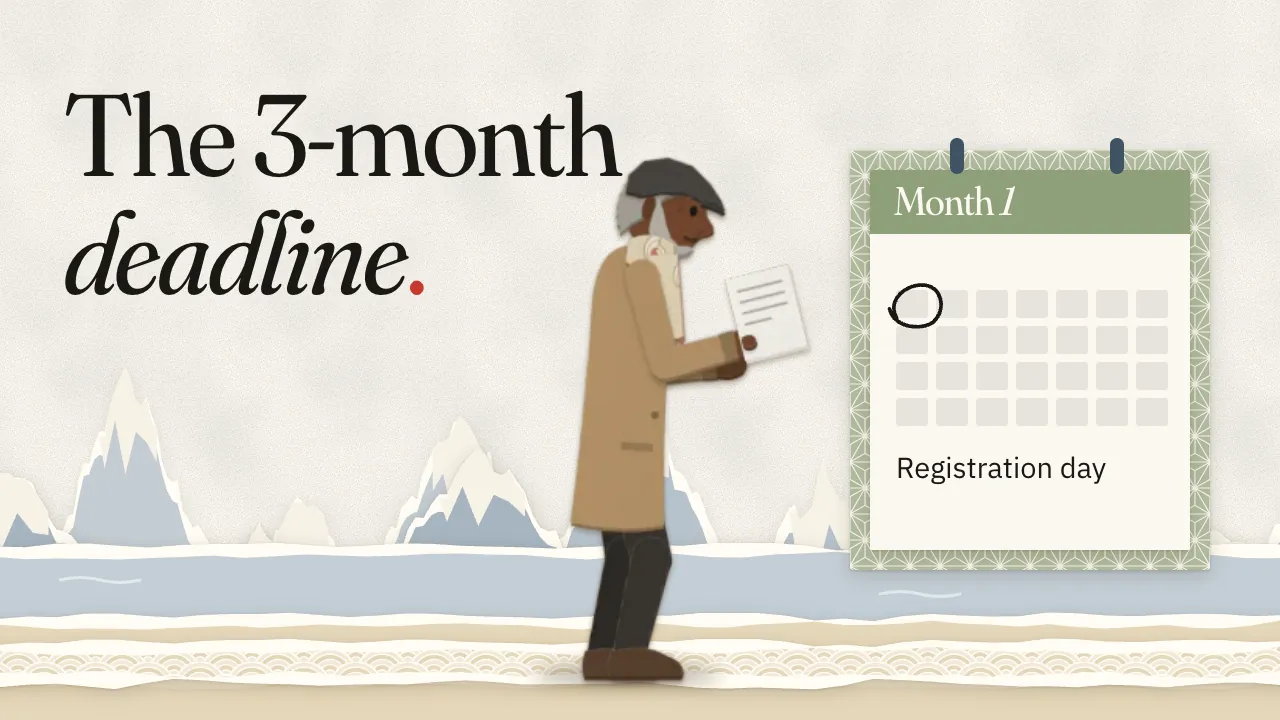
Video · 2:42 New in Switzerland? The 3-month health insurance deadline
Video page, chapters and transcript
Chapters
- 0:00The date that starts at registration
- 0:50What happens if you miss it
- 1:13Every basic insurer must accept you
- 1:31What to do in your first weeks
- 1:56Basic now, supplementary with care
- 2:23Your first Swiss insurance review
Read the transcript
0:00 The date that starts at registration
New in Switzerland? How long do you have to take out health insurance, and what if you miss the deadline? The short answer: three months from registering with your commune. Enrol in time, and cover starts on your registration date. The clock does not start when you arrive. It starts when you register with your commune, in your first 14 days. A baby born here needs its own policy, within three months of the birth. Say you register today, and you enrol two months from now. Your cover still starts today, so there is no gap. Your premiums start today too. So waiting saves nothing, and rushing earns nothing. Use the time to get your choices right.
0:50 What happens if you miss it
Now the trap. Miss the three months without a valid excuse, and cover starts only on the day you enrol. Treatment in the gap is yours to pay, and a premium surcharge applies for a limited period. Never act, and the canton can assign you an insurer. If you are late, don't wait for that letter: enrol today.
1:13 Every basic insurer must accept you
Enrolling is the easy part. Every basic insurer must accept you, whatever your nationality or health, and the benefits are identical everywhere. Insurers typically confirm within days, and most will take your application before you even arrive.
1:31 What to do in your first weeks
So, what to do in your first weeks. Register with your commune, and keep the paperwork. Pick your model, deductible and accident cover; if you work 8 hours a week or more for one employer, your employer already insures accidents. Compare premiums for your postcode. Then apply, well inside the three months.
1:56 Basic now, supplementary with care
Supplementary insurance is different. It is optional, and the insurer asks about your health, so it can exclude a condition or decline you. Our advice: decide it in your first weeks, while every option is open. That is advice, not a legal deadline. Answer every question fully, including treatment abroad. And sometimes the honest answer is to skip it.
2:23 Your first Swiss insurance review
If you'd like someone to read your own contracts with you, book your first Swiss insurance review. It's free, 45 minutes, in English, with Robert or Nicole. The link is in the description.
Moving to Switzerland? Five situations, five first moves.
Moving soon: you can prepare almost everything.
Most insurers accept applications before you arrive — the policy simply starts on your registration date. Gather the six facts below, run the comparison, and land with the decision already made. Only the cantonal registration itself waits for arrival.
Just arrived: register first, then sequence calmly.
Cantonal registration in your first 14 days, then the three-month sequence. You have time — and because cover and premiums run from your registration date anyway, there is no rush-bonus and no waiting-bonus. Use the time to get the five choices right.
One to three months in: decide now, comfortably.
The deadline is real but not close enough for panic. Check the timeline, settle franchise and model, and enrol — acceptance is mandatory, so the only risk left is choosing a setup that doesn't fit. That's what the review checks.
Deadline maybe missed: enrol today.
If the delay has no valid excuse, cover begins only when you enrol — the gap is uninsured — and a surcharge applies (Art. 5 KVG). Don't wait for the canton to act. What actually happens, and the way back.
Student, cross-border, or international cover: check the exception first.
Some categories can stay outside KVG — but only with a cantonal exemption decision, applied for within the same three months. Don't assume; verify your case before paying double or missing the window.
Bring these six facts to the first review.
The first consultation should not start with product names. It should start with the facts that decide the legal deadline, the premium architecture, and whether optional cover is still worth applying for.
| Fact | Why it matters | What to bring |
|---|---|---|
| Registration date | Confirms the 3-month deadline we need to work against | Bring Gemeinde/canton registration confirmation |
| Accident coverage | Employees over 8 hours/week are usually covered by employer accident insurance | Bring employment contract or HR confirmation |
| Family members | Every resident needs their own basic policy; children are separate | Bring spouse/child arrival and registration dates |
| Franchise and model | Controls premium and access path to doctors | Tell us your expected doctor usage and GP needs |
| Supplementary timing | Optional, underwritten, and harder after health events | Bring any existing medical context honestly |
| International cover | Some people need exemption or IPMI review instead of domestic setup | Bring current policy if you may be exempt |
This is the setup table we use before comparing insurer names.
How to get health insurance in your first three months.
Two kinds of dates live in a newcomer's first months, and they deserve different weight: the deadlines federal and cantonal law set, and the planning rhythm we recommend from a decade of arrivals. Each step below says which it is.
First 14 days Required · cantonal law
Cantonal registration (Anmeldung)
Keep the Gemeinde or canton paperwork. We use it to verify the federal three-month insurance deadline against the canton.
Weeks 1–4 Recommended by us
The first review
We sequence insurer, franchise, model, accident cover, and supplementary timing — early, while every option is still open. This is our planning advice, not a legal stage.
Weeks 2–4 Recommended by us
Supplementary application, if it fits
Supplementary is underwritten (Art. 4 VVG) — future diagnoses or treatment can affect acceptance, so applying early protects the option. Answer every health question fully, including treatment abroad. There is no official deadline; this timing is our experience. Whether it is worth it for you: supplementary health insurance, worth it or not.
Within three months Required · Art. 3 KVG
Basic insurance enrolled
Acceptance is mandatory under Art. 5 KVAG. Enrolled on time, cover and premiums run retroactively from your registration date — then we check card, AHV, payment setup, and the Hausarzt network before the deadline closes.
If missed The law · Art. 5 & 6 KVG
Enrol immediately — the gap is the cost
An unexcused late enrolment means cover begins only when you enrol — treatment in the gap is yours to pay — plus a premium surcharge for a limited period (Art. 5 KVG). The canton can also assign you to an insurer (Art. 6 KVG). Don't wait for that letter.
What's mandatory, what's optional.
Two contracts, two laws, two different rules. Most newcomers conflate them. Federal-law clarity first; the choice architecture follows.
Basic — KVG
Mandatory. Federal benefits identical.
Required for every Swiss resident under Art. 3 KVG. Catalogue of covered medical care identical at every insurer (Art. 25 KVG). 30+ Swiss basic insurers; you choose freely (Art. 4 KVG). Children pay a reduced premium; several children of one family at the same insurer share a cost-sharing cap (Art. 64 §4 KVG, Art. 93 §3 KVV).
- Cantonal premium tariff approved annually by BAG
- Six legal Franchise tiers (Art. 93 KVV)
- Annual cancellation right by 30 November (Art. 7 KVG)
- Acceptance is mandatory — no underwriting
Supplementary — VVG
Optional. Underwritten individually.
Hospital supplementary (semi-private, private, worldwide). Outpatient supplementary (complementary medicine, prevention, dental). Travel and emergency abroad. All underwritten individually (Art. 4 VVG) — reviewed early, decided honestly.
- Apply early if the cover fits — future health events can affect acceptance (our advice, not a legal deadline)
- Health questionnaire covers treatment in Switzerland and abroad — answer fully; incomplete answers can void the contract (Art. 6 VVG)
- Past condition → exclusion, surcharge, or rejection — we assess honestly before you apply
- Genuinely optional: sometimes our recommendation is to skip it
Mandatory is mandatory; optional is genuinely optional. We say "don't take the supplementary you don't need" more often than the market suggests we should.
Four facts set the price. Five choices are yours.
Your canton and address, your age, your household, and your employment are facts — they define the tariff grid you shop in (Art. 61 KVG; premium regions within cantons; cantonal IPV subsidies). Everything else is a choice, and every choice interacts with the others. We sequence them in the first review.
| Canton | Arriving now2026 premiums, until 31 December | From 1 January2027 premiums |
|---|---|---|
| Zug | CHF 431 | CHF 444 |
| Zürich | CHF 544–640 | CHF 570–677 |
| Geneva | CHF 752 | CHF 771 |
Standard model, Franchise 300, accident included; Zürich by premium region (FOPH premium data). Enrol this autumn and you pay the 2026 premium until 31 December, the 2027 premium from 1 January. Your postcode, insurer by insurer
Choice 01
Insurer.
Federal benefits identical (Art. 25 KVG). Choice runs on premium, model availability per canton, claim-handling reputation, and supplementary product range. Most newcomers default to the largest insurer in their canton; the largest is rarely the cheapest.
Choice 02
Franchise.
Six legal adult tiers under Art. 93 KVV: 300, 500, 1,000, 1,500, 2,000, 2,500. Children: 0–600. The right tier depends on actual care usage and the household's risk appetite. We routinely see newcomers default to 300 — often the most expensive path for a healthy adult, though never a universal rule.
Choice 03
Model.
Standardmodell, Hausarzt, HMO, Telmed, Pharmed. Model discounts move premiums materially within the same insurer — names and rules differ per insurer. English-language model availability varies by canton; Hausarzt means committing to a network GP, so verify availability before signing.
Choice 04
Accident cover — in or out.
Employed 8+ hours a week with one employer? Your employer already insures you against accidents (UVG), and accident cover can be suspended from your basic policy on proof of employment — the median Zürich saving is CHF 421/year on 2026 tariffs and CHF 443/year from 1 January 2027 (FOPH data). Not employed, self-employed, or under 8 hours? Keep it in. Newcomers routinely pay twice without knowing.
Choice 05
Supplementary — yes, later, or no.
The one genuinely optional layer, and the one with underwriting. Reviewed early, decided honestly — sometimes the answer is no supplementary at all. The full logic sits one section down.
Where foreigners usually start — by situation.
Basic benefits are identical, so a shortlist comes down to the premium in your canton, the model that fits your doctors, and service in English. It is a starting point for the review, not a recommendation to sign.
Single professional, employed
- Your employer already insures accidents (UVG) from 8 hours a week: suspend accident cover in the basic policy on proof of employment.
- Compare the same model and deductible across insurers for your postcode; a higher deductible suits low expected care.
- Confirm an English-speaking GP is in the network before choosing Hausarzt.
Couple, both working
- Each adult needs their own policy; they can differ in insurer, model and deductible.
- Set each deductible on that person’s expected care, not as a pair.
- If both are employed, accident cover can come out of both basic policies.
Family with children
- Every child needs their own basic policy; children’s deductibles run 0–600.
- Children of one family at the same insurer share a cost-sharing cap.
- Read family health insurance in Switzerland before you sign.
Planning a pregnancy
- Basic insurance covers maternity for everyone; acceptance is mandatory.
- Supplementary is underwritten: a pregnancy is a health event, so decide the question before conception, and register a baby before birth for cover without health questions.
- See maternity and newborn insurance.
Arriving with international cover from an employer
- Exemption is possible only under Art. 2 KVV and only by cantonal decision; apply before your three months run out.
- Check the plan meets Swiss equivalence before you cancel or skip anything.
For the insurers themselves, see all 11 insurers ranked. Our full ranking is in the best health insurance in Switzerland.
Supplementary insurance, honestly.
Supplementary cover is a separate, voluntary contract with a health questionnaire (Art. 4 VVG). Two things are true at once: applying early can protect the option — because a diagnosis next year can close doors that are open today — and every question must be answered fully and accurately, including treatment abroad. Both halves matter. We help with both.
Apply early. Answer everything.
The early timing is our advice from a decade of arrivals, not a legal deadline. The full answers are the law.
01
What the questionnaire asks
Hospitalisations, surgeries, medication, mental-health treatment, chronic conditions — explicitly including treatment in Switzerland and abroad. Incomplete or inaccurate answers can void the contract later (Art. 6 VVG), usually exactly when you need it.
02
Why early timing helps
Underwriting assesses your health as it stands on application day. A diagnosis, treatment, or pregnancy that arrives later can mean exclusions, surcharges, or refusal — for cover you could have had cleanly before. Timing protects options; it never replaces disclosure.
03
What we recommend for newcomers
Decide the supplementary question in your first weeks — decide, not necessarily buy. Signing a first Swiss lease usually raises two more policies in the same month — household contents and personal liability, and legal protection — which we read in the same review. If a partner, a child or a mortgage depends on your income, term life insurance belongs in that conversation too.
04
If the wished cover isn't achievable — or isn't needed
We assess your situation honestly and tell you before you apply. Where standard terms aren't realistic, we propose alternatives: an insurer whose underwriting treats your condition more favourably, an adjusted product tier, or international (IPMI) routes. And where supplementary simply isn't worth it, the Private Client Report says so in writing.
We check the sequence before anything is signed.
For newcomers, the useful review is not a product list. It is the deadline, accident cover, franchise, model, and the supplementary question — in the right order, and then in writing.
-
The deadline, verified
Your registration paperwork against the canton — the exact date your three months end, and what's already covered retroactively.
-
The facts, sorted
Accident cover in or out, every family member's own policy, and whether an exemption case applies before anything else is decided.
-
The five choices, sequenced
Insurer, franchise, model, accident cover, supplementary — run against your household, your doctors, and your plans, not a price list.
-
Your Private Client Report
Within 3 working days, everything in writing: what to set up, what to skip, the reasoning, and the next administrative step. Robert runs the health setup; Nicole joins if pension, 3rd pillar, or cross-border tax appears.
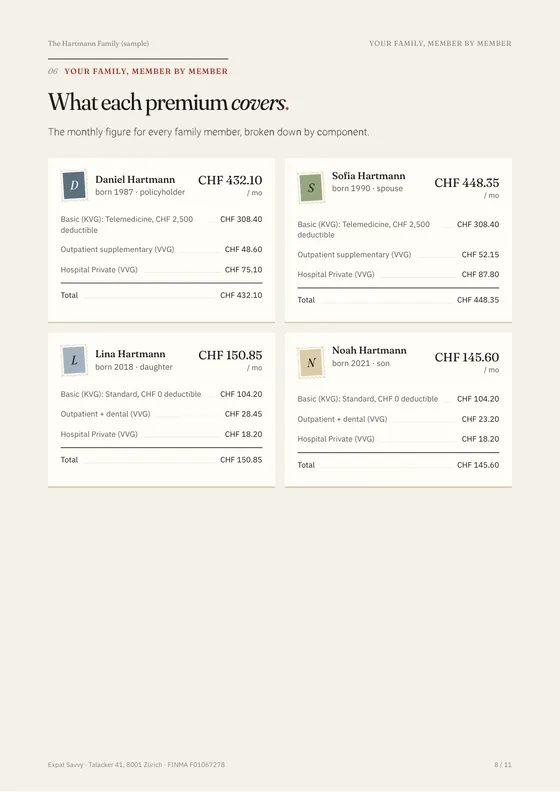
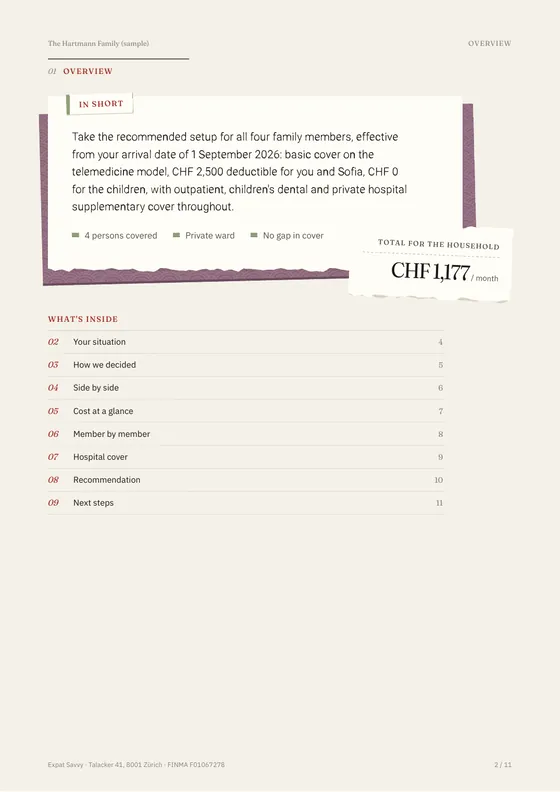
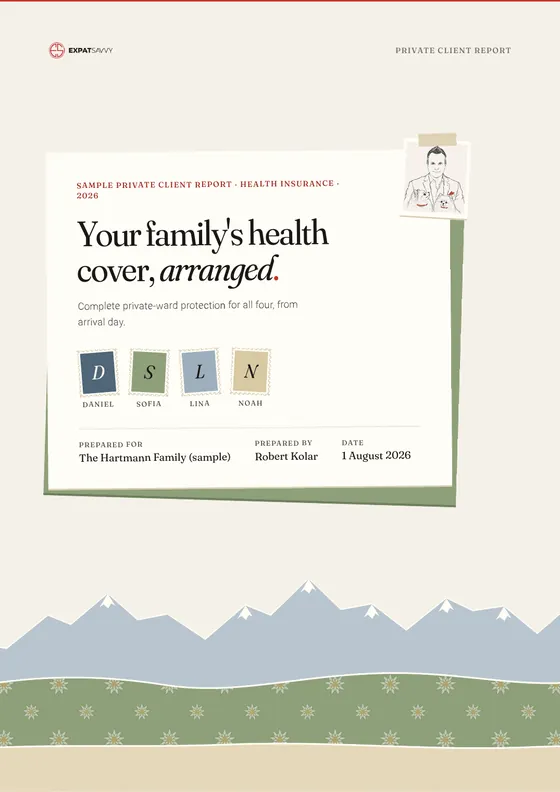
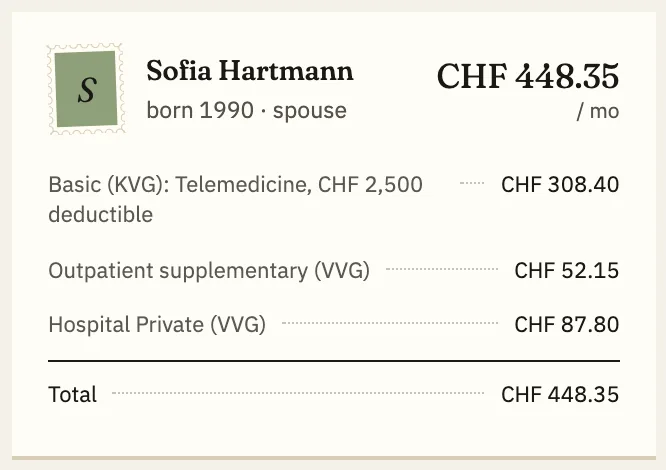
Read the full sample · Download the PDF · What's inside
A worked example — family arriving from London.
A family of four — both adults employed in Zürich, kids ages 7 and 11 — arrived from London in late January. Day 5 in Switzerland, before any medical events, they came to us. The first review covered five decisions in 45 minutes.
Registered by day 30.
By day 60, paediatrician and GP routes were mapped. The 3-month deadline was met with margin to spare.
- Insurer
- Zürich Region 2 premium curves compared across three insurers.
- Franchise
- Adults at 1,500, children at 300 — roughly CHF 2,000/year less than the default low-franchise setup, on 2026 and 2027 tariffs alike.
- Model
- Hausarzt, because the preferred English-speaking GP was already in-network.
- Timing
- Semi-private supplementary applied for in their second week — full health disclosure, clean acceptance.
Aggregated from real client patterns, spring 2026 — no individual client identified. Zürich Region 2 tariffs; savings depend on household and usage, never guaranteed.
EU citizens, cross-border commuters, students — the exceptions.
Four scenarios where the standard newcomer sequence needs adjustment. We handle each with a different first move.
Executives with employer-paid IPMI
Some executive packages include international medical insurance (IPMI) that meets Swiss equivalence requirements for KVG exemption under Art. 2 KVV. The exemption is not automatic — it requires an application to the cantonal authority with documentary proof, before your three-month deadline to insure runs out (Art. 7 KVV). For these cases we work with sip.ch, who specialise in international / IPMI insurance for executives. Misjudge the exemption and the household pays Swiss basic premiums alongside an international plan they don't need. Detailed walk-through in our IPMI vs Swiss supplementary piece.
Cross-border workers (Grenzgänger)
Workers commuting daily from neighbouring countries (Germany, France, Italy, Austria) into Switzerland have specific cross-border insurance options under EU/EFTA agreements. The choice between Swiss KVG, home-country compulsory cover, or a private cross-border plan depends on family situation, income, and which side of the border medical care will primarily occur. We work with cross-border specialists on these cases.
Students
Students with home-country health insurance meeting Swiss equivalence requirements may apply for KVG exemption (typically renewable each academic year). University-arranged international student insurance often qualifies. Verify equivalence with the cantonal authority before assuming exemption.
Late arrivals — deadline already missed
Two consequences, and the first is the expensive one: if the delay has no valid excuse, coverage begins only when you actually enrol — treatment in the uncovered gap is yours to pay — and a premium surcharge applies for a limited period (Art. 5 KVG). Separately, the canton monitors compliance and can assign you to an insurer if you don't act (Art. 6 KVG). The first move is always the same: enrol immediately, then plan a switch to the right setup at the next 30 November cancellation (Art. 7 KVG). Detailed mechanics in our cancellation-deadline reference.
Not sure whether Swiss cover is even the right route? Read Swiss vs international health insurance.
Why a comparison portal isn't a setup.
Comparis.ch and similar comparison portals are useful for premium comparison once you have decided your canton, age band, and Franchise tier. They are not a substitute for setting up your insurance for the first time. The structural difference: comparison portals do not read your contract, do not consult you on your expectations and needs, do not judge which supplementary setup makes sense for you, and do not run the lever calculations against your specific situation.
| Comparison portal | Independent advisor (us) | |
|---|---|---|
| Reads your situation | No | Yes — 45-minute review |
| Runs canton × age × model × Franchise math | Premium-only | All four levers |
| Verifies KVG-exemption eligibility | No | Yes — case-by-case (executives, students, cross-border) |
| Decides the supplementary question honestly | No | Yes — early, fully disclosed, sometimes "skip it" |
| Consults on needs and expectations before choosing supplementary | No — product filters only | Yes — hospital, outpatient, family, travel, and future-use fit |
| Operates in English | Some | Yes — primary language |
We use priminfo.ch — the federal premium portal — ourselves for cross-canton premium lookup. We use Comparis when a reader asks us to. Neither is a replacement for the first setup. The longer answer to what an independent Swiss insurance advisor is sits at our positioning piece.
The insurer you sign with today won't stay cheapest.
Every officially approved Zürich premium, 2016–2026. "Signing once and never reviewing" cost the decade's arrival cohorts between CHF 0 and CHF 1'766 a year — a lottery decided by which insurer happened to win your arrival year. The yearly review removes the lottery.
Slide to your arrival year — the full interactive index: regions, insurers, inflation
FAQ.
Can foreigners get Swiss health insurance?
How do I get health insurance in Switzerland?
Do EU citizens need Swiss health insurance?
How long does it take to get health insurance in Switzerland?
How long do I have to register for Swiss health insurance after arriving?
Can I arrange Swiss health insurance before I arrive?
Is health insurance mandatory in Switzerland?
Are basic-insurance benefits the same across all Swiss insurers?
What happens if I miss the 3-month registration deadline?
Can I keep my international or home-country health insurance instead of Swiss basic insurance?
When should I apply for supplementary insurance as a newcomer?
What's the average Swiss basic-insurance premium for a new arrival?
Do I need to find an English-speaking GP?
Can my children be added to my insurance automatically?
What's IPV and how do I know if I qualify?
Can I cancel my Swiss basic insurance and switch insurer in my first year?
Do I need a Swiss bank account before I register for insurance?
What clients say
★★★★★
I was a bit lost with all the administrative procedures after moving to Switzerland, especially regarding my health insurance situation. Nicole took the time to understand my case and explain everything very clearly. She answered all my questions, explained the legal aspects and gave me practical advice on how to move forward. What I appreciated the most is that she was trying to help me solve my problem, not simply sell me an insurance policy.
★★★★★
Robert is the best person to partner with if you need to do difficult things such as relocate and navigate the complications of healthcare insurance in Switzerland. Robert went beyond what was expected and in a very caring way making sure that we had a really good arrival in Switzerland.
★★★★★
After returning to Switzerland from abroad, Robert from Expat Savvy was a tremendous help consulting me about all the changes. He took the time to show me several options and definitely went the extra mile compared to other agents.
★★★★★
My session with Robert — without a doubt — was one of the most efficient consultation sessions I'd ever had. He is honest, straightforward and transparent from the outset. He knows the insurance industry inside out. He helped me with my situation without any reservation. You confide to him within minutes into the session and take his honest and unbiased advice.
See more reviews
★★★★★
Extremely helpful and knowledgeable consultation in all facets of current health insurance offerings. Highly recommend consulting Expat Savvy before making any online insurance comparisons.
★★★★★
I had an excellent experience working with Nicole Bohne. She assisted and guided me through the entire process of obtaining my Swiss pension refund, making what could have been a complicated process incredibly straightforward and stress-free. Nicole was always friendly, professional, knowledgeable, and extremely efficient. She kept me informed every step of the way, answered all my questions promptly, and ensured everything was handled smoothly from start to finish. I highly recommend Nicole and her company to anyone needing assistance with Swiss pension refunds or related services.
★★★★★
I highly recommend this office for all types of insurance. After having several bad experiences with other brokers, working with Mr. Robert Kolar was a completely different experience. He is incredibly professional, friendly, and solved my complex insurance problems in a timely manner. What I appreciated most was that he took all the time needed to make sure I truly understood my policies.
★★★★★
I had an excellent experience working with Robert. I was looking to change providers for one of my supplementary insurance plans, and he guided me through the process with professionalism, patience, and expertise. Thanks to his guidance, I was able to secure a policy that perfectly suits my needs.
★★★★★
Working with Ben was great. Very prompt and responsive. Would highly recommend to anyone!
★★★★★
Benjamin überzeugt durch seine hervorragende Organisation und klare Kommunikation, Robert durch seine kompetente und ehrliche Beratung. Beide arbeiten Hand in Hand und haben die individuellen Anforderungen unserer Kunden immer im Blick — absolut empfehlenswert!
Set it up right. The first time.
Your first three months decide the insurance architecture you may live with for years. We read the setup, check the deadline, and send your Private Client Report — a written, in-depth analysis — within 3 working days of the review (read the actual sample).
Book your first Swiss insurance review