Health insurance
Swiss health insurance models — Hausarzt, HMO, Telmed, Pharmed.
Most expats pick Standard and overpay every year. The 2027 read on KVG models — Hausarzt, HMO, Telmed, Pharmed — and which fits which life.
Key takeaways
- Most expats default to Standard and overpay CHF 500–1,500 per adult per year. Alternative models — Hausarzt, HMO, Telmed, Pharmed, and digital hybrids — offer discounts of 7–22% on the same basic coverage.
- All KVG models cover exactly the same benefits by law. The only difference is how you access care — the first point of contact changes, not the coverage.
- The right model isn't the cheapest — it's the one that matches how you actually use healthcare. Sometimes that's Standard.
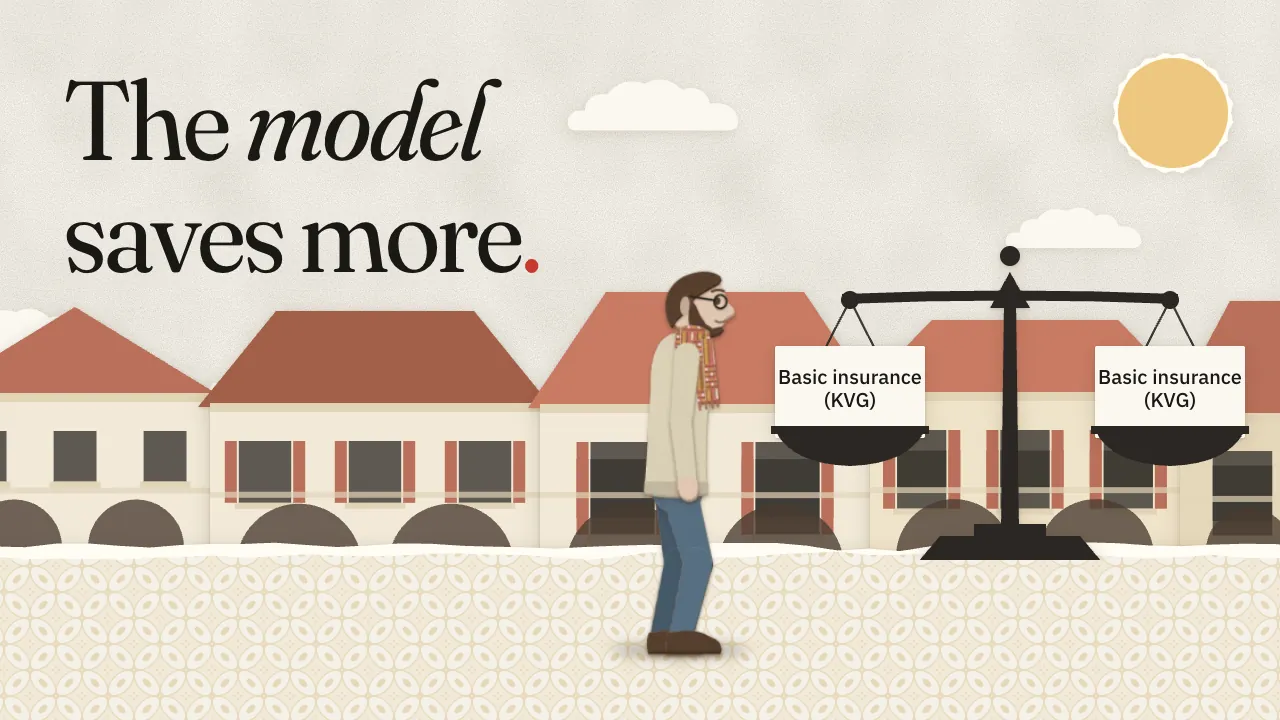
Video · 2:52 Cheapest Swiss health insurance 2027: what it really saves
Video page, chapters and transcript
Chapters
- 0:00Is the cheapest insurer worse?
- 0:15What the cheapest saves
- 0:52The model saves more
- 1:34Can I still see an English-speaking doctor?
- 1:57The bigger number: supplementary
- 2:16Four decisions, in order of weight
- 2:32Your first Swiss insurance review
Read the transcript
0:00 Is the cheapest insurer worse?
What is the cheapest health insurance in Switzerland for 2027? And is the cheapest insurer worse? No. Basic cover is exactly the same at every insurer, by federal law.
0:15 What the cheapest saves
The cheapest adult premium in Switzerland is CHF 227.50 a month, on an HMO model in Zug. But the cheapest insurer saves less than you think, and changing your insurance model saves more. In the seven cities we track, the cheapest insurer costs CHF 38.50 to 59.80 a month less than the median one. Real money, but the smallest of four decisions. And it rarely stays cheapest: in 14 of the 26 cantons, the cheapest is now a different insurer.
0:52 The model saves more
Changing model saves more. At KPT in Zürich, Standard costs CHF 535.60 a month, Telmed 428.50. At seven major insurers there, the cheapest model saves CHF 98.20 to 147.20 a month. The cover stays exactly the same. Only your first point of contact changes. Family doctor: your GP first. HMO: a group practice. Telmed: a phone or video call. So pick the model first, and the insurer second.
1:34 Can I still see an English-speaking doctor?
Can you still see a doctor who speaks English? With Telmed, usually yes: Medgate, behind most major insurers' Telmed lines, consults in English, around the clock. Check your insurer's line first. If you want a doctor in person from the first contact, Standard or the family doctor model remain the right call.
1:57 The bigger number: supplementary
The bigger number is supplementary insurance. It is optional, it varies widely between insurers, and it is where most expats over-buy, often by one or two tiers in their first year. Getting it right usually saves more than the cheapest basic insurer.
2:16 Four decisions, in order of weight
So decide in order of weight: supplementary, model, deductible, and only then the cheapest insurer. Check your figure on priminfo.ch, and cancel by 30 November, for 1 January.
2:32 Your first Swiss insurance review
If you'd like someone to read your own contracts with you, book your first Swiss insurance review. It's free, 45 minutes, in English, with Robert or Nicole. The link is in the description.
Every Swiss health insurer offers the same basic coverage — identical benefits, identical legal obligations, identical claims catalogue. The only thing that changes between insurers is the premium and the service. And the single biggest lever on the premium — larger than switching insurers, larger than changing your franchise — is the insurance model you choose. Most expats pick Standard by default and overpay by several hundred francs per adult per year. This post explains why, and which model actually fits.
The cost of being on Standard by default.
Standard means free choice of doctor — any licensed physician in Switzerland, any time, no referral needed. It’s the most expensive model because it’s the most flexible. Every alternative model offers a discount on the Standard premium in exchange for routing your first medical contact through a specific channel: your GP, an HMO clinic, a telephone triage line, or a pharmacy.
The discount ranges are meaningful. Switching from Standard to a Hausarzt model on a typical Zürich adult premium saves roughly 8–15% — which on the 2027 median Zürich-city Standard premium at the CHF 2,500 deductible (CHF 549.75, FOPH data) works out to CHF 44–82 per month, or CHF 528–990 per year per adult. For a couple, that’s approaching CHF 2,000 per year — for the same coverage.
Swiss KVG basic-insurance models, 2026 — premium discount, primary contact, constraints.
| Model | Premium discount | Primary contact | Escalation | Geographic constraint |
|---|---|---|---|---|
| Standard | No discount (baseline) | Any doctor in CH | Direct | None |
| Hausarzt (free GP) | ~8–10% | Any Swiss GP you designate | Via your GP | None |
| Hausarzt (insurer list) | ~10–15% | GP from insurer’s approved list | Via your GP | List varies by insurer |
| HMO | ♦ ~8–20% | Group practice | Within the practice | Major cities only |
| Telmed | ~4–19% | Phone / video triage | Triage refers if needed | None |
| Pharmed | ~5–12% | Participating pharmacy | Pharmacist refers if needed | Cantons with pharmacy networks |
| Digital hybrid | ♦ up to ~22% | App-based triage | App escalates to telmed / GP | Varies by product |
All seven rows cover exactly the same benefits by federal law. The difference is the first point of contact — not the coverage, not the hospital access, not the prescription rights. The savings are real and the coverage is identical.
Quick check
Want us to check which model fits how you actually use healthcare?
Standard — the most expensive default.
Complete freedom to consult any licensed doctor in Switzerland without referral, any time. No gatekeeper, no routing, no app. The full cantonal reference premium with no discount.
When Standard fits: people with established specialist relationships outside any GP network, those who see multiple specialists regularly without wanting referrals, frequent travellers who use Swiss doctors irregularly, and those who simply value full freedom and willingly pay for it. Standard is wrong for most expats most of the time — but it’s right for some specific situations, and we tell clients this honestly.
Hausarzt — and its two sub-variants.
The family-doctor gatekeeper model. All non-emergency care starts with your designated GP, who refers you to specialists when needed.
Hausarzt with free GP choice.
Pick any Swiss GP as your designated family doctor. Lower discount (typically 8–10%) because the insurer has less control over costs. Highest flexibility within the Hausarzt category — your GP doesn’t need to be on any list.
Hausarzt-Liste (insurer-network GPs).
Pick from your insurer’s approved list of GPs. Higher discount (typically 10–15%) because the insurer has negotiated rates with network doctors. The list varies by insurer and by region — verify your preferred GP is on the list before switching. If you move or your GP retires, you must pick a replacement from the list.
When Hausarzt fits: people who already have a GP they trust and prefer in-person consultations for everything. When it doesn’t: people without a primary GP, frequent specialist users who’d find the referral requirement frustrating, or those whose preferred GP isn’t on the insurer’s list.
HMO — group practice integrated care.
All medical contact routes through a group medical practice with multiple specialties under one roof. You don’t choose a single GP — you’re assigned to the practice. The discount is typically 8–20%, among the highest of the traditional models.
The constraint: HMO requires a physical group practice near you. HMO networks exist mainly in major Swiss cities — Zürich, Bern, Basel, Lausanne, Geneva, Lucerne. If you live outside these areas, HMO typically isn’t available.
When HMO fits: residents of major cities who use healthcare actively and like the convenience of multiple specialists at one location — no external referrals, shorter coordination time. When it doesn’t: residents outside HMO geography, those with established external specialist relationships they want to keep, or those who want to choose their specific doctor.
Telmed — first contact by phone or video.
The initial consultation happens via tele-medicine — a trained medical advisor assesses your situation by phone or video and decides whether you need in-person care. If you do, they refer you. Discount typically 4–19%, depending on insurer and region.
Telmed is the model that’s expanded most in the last three years. Nearly every major Swiss insurer now offers a Telmed variant:
- CSS CallMed — Medgate-based telmed
- SWICA Favorit Telmed — SWICA’s telmed model
- Sanitas Compact One — fully digital, Medgate triage, English-language
- Helsana BeneFit PLUS — telmed with Medgate and Helsana+ integration
- Concordia smartDoc — Medgate-first basic model
- Visana TelDoc — Well-app-based telmed
- Sympany callmed 24 — telmed with a unique advantage: consultations under callmed 24 have no deductible and no copay
- Atupri FlexCare — hybrid Telmed + HMO, available in Zürich, Bern, and Lucerne
When Telmed fits: digital-first users, people with mostly straightforward medical needs, English-only speakers who benefit from Medgate’s English-language service. When it doesn’t: people who strongly prefer in-person consultations from the first contact, or those with complex conditions that benefit from seeing the same doctor face-to-face each time.
Pharmed — pharmacy first contact.
A newer model. First contact for non-emergency care happens at a participating pharmacy. The pharmacist provides initial advice, basic screening, and refers to a doctor if needed. Discount typically 5–12%.
Available with certain insurers in cantons with strong pharmacy networks. Sympany casamed pharm is one of the more established variants.
When Pharmed fits: people in cantons with dense pharmacy coverage who prefer face-to-face initial consultations but don’t need a doctor for routine matters — minor illnesses, medication questions, renewal assessments. When it doesn’t: residents in cantons with weak pharmacy coverage, or those who want a doctor, not a pharmacist, as the first medical contact.
Hybrid and digital-first models — the 2026 evolution.
The newest category. Insurer-specific products that combine app-based digital triage, telmed escalation, and in-person care into a single hybrid model. The deepest premium discounts come from this category:
- KPT KPTwin.smart — fully digital, advertising up to 22% savings via the Well symptom-checker app
- Sanitas Compact One — fully digital Medgate triage in English
- Atupri FlexCare — hybrid Telmed + HMO in Zürich, Bern, and Lucerne
- Groupe Mutuel Alternative Flexible — flexible first-contact across multiple channels, advertising up to 24% in some cantons
The trade-off: the deepest discounts come with constraints. Some products include multi-year commitments. Others require you to use the insurer’s specific app for every medical contact. The savings are real — the question is whether you’ll be comfortable inside the model in year three.
Which model fits which person.
-
You see a GP for everything, rarely specialists.
Hausarzt-Liste at your insurer of choice. Highest discount within a flexibility tier you'll comfortably use. Verify your GP is on the list before switching.
-
You live in a major city and use healthcare actively.
HMO. The group practice convenience pays back the constraint — multiple specialties under one roof, no external referrals, shorter coordination time.
-
You're digital-first and English-only.
Telmed via Medgate (Sanitas Compact One, CSS CallMed, Helsana BeneFit PLUS, and others) or a digital-first hybrid like KPTwin.smart. Deepest discount; English-language telmed integration is genuine.
-
You have specialist relationships you can't transfer.
Standard. The freedom is worth the premium for some specific situations. We tell some clients this honestly — the model that fits is not always the cheapest one.
The four traps in model choice.
trap 01
The age-curve trap.
Some supplementary plans are cheap at 32 and brutal at 55. We model the 20-year cost, not the signup price.
trap 02
The 3-month deadline.
New residents must register for basic insurance within 3 months or face penalty surcharges and canton-assigned coverage.
trap 03
Coverage that pays vs. coverage that fights.
Every insurer's brochure looks generous. The real question is which ones actually approve claims.
trap 04
We match coverage to your life.
We check actual needs and recommend only what fits, even if that means fewer products than expected.
The longer reference on each trap — federal-law foundation, the typical misunderstanding, the cost, what we do — sits in the four-traps deep dive.
These four traps map directly to model decisions. The age-curve trap is the Standard inertia trap — staying on the most expensive model by default, year after year. The three-month deadline is the November switching deadline — miss it and you’re locked in for another year. Coverage-that-pays is the difference between choosing a model based on the brochure discount and choosing one based on how you actually access care. And matching coverage to your life is the honest question: does the model fit how you use healthcare, or are you forcing your healthcare into a model that saves money on paper but adds friction in practice?
The honest answer.
For most expats most of the time, the right Swiss insurance model is not Standard — but it’s not always the cheapest model either. The decision turns on three questions: how often do you actually see a doctor, where do you live, and how comfortable are you with digital-first triage? The premium savings are large enough to be worth thinking about deliberately, and small enough that picking the wrong model is recoverable next year — provided you didn’t sign a multi-year hybrid contract.
If you’ve been on Standard for more than a year and haven’t run the numbers on the alternatives, this is one of the highest-leverage conversations available to you. The annual saving of getting the model right typically runs to several hundred francs per adult — and across a family, across a decade, it compounds into real money.
Frequently asked.
What are the basic Swiss health insurance models?
Which Swiss insurance model is the cheapest?
What is the difference between Hausarzt and HMO?
Can I switch my insurance model during the year?
What is Pharmed?
What if I miss the 30 November switching deadline?
Should I always pick the cheapest model?
By the team