
Swiss 3a — bank or insurance? When each fits.
Banking 3a (VIAC, frankly, finpension, traditional bank 3a) is cheaper, more flexible, and market-tracking. Insurance 3a (life-insurance-wrapped pillar 3a) adds premium waiver in disability and a guaranteed death benefit. We sell insurance 3a where it fits an actual coverage gap. We tell clients when banking 3a is the cleaner answer — that's the disclosure.

Reviewed by Nicole Bohne, life insurance advisor — life, 3rd pillar, tax optimization · FINMA F01536402 · Last updated 11 June 2026







45 minutes with Nicole. Free.
In English · With or
We'll send you a short intake form so we understand your needs before we speak.
Your details
You're booked
Check your email for a calendar invite and a video call link.
In brief
Banking 3a: a custody account at a bank or fintech (VIAC, frankly, finpension, traditional bank 3a). Cheaper TER (0.0–0.5% typical), flexible contribution cadence, market-tracking ETF allocations. Suits households with no specific coverage gap. Insurance 3a: a life-insurance contract wrapped around the pillar 3a tax framework. Adds premium waiver in disability (premiums continue at no cost if you can't work) and a guaranteed death benefit for dependents. Higher cost (insurer overhead built in); makes sense only where there's an actual coverage gap that warrants the wrap. Most clients hold both — and most clients without a clear gap should hold banking 3a only.
Can expats open a pillar 3a? Yes — with Swiss AHV income.
Yes. Any expat with earned income subject to Swiss AHV contributions can open a pillar 3a, at a bank or through an insurer — nationality and permit type don't matter (Art. 7 BVV3). The open question is which of the two fits you, and that is what this page is for. The full 3a overview covers the rest.
Read this before the comparison.
Expat Savvy is an independent insurance advisory regulated under Article 45 VAG, FINMA-registered F01067278. We sell insurance 3a — life-insurance-wrapped pillar 3a contracts. We do not sell banking 3a apps (VIAC, frankly, finpension, traditional bank 3a). We earn commission on insurance-3a contracts, disclosed under Art. 45 VAG. We earn no commission on banking-3a recommendations. The comparison below is honest because we have nothing commercial to gain from a banking-app recommendation.
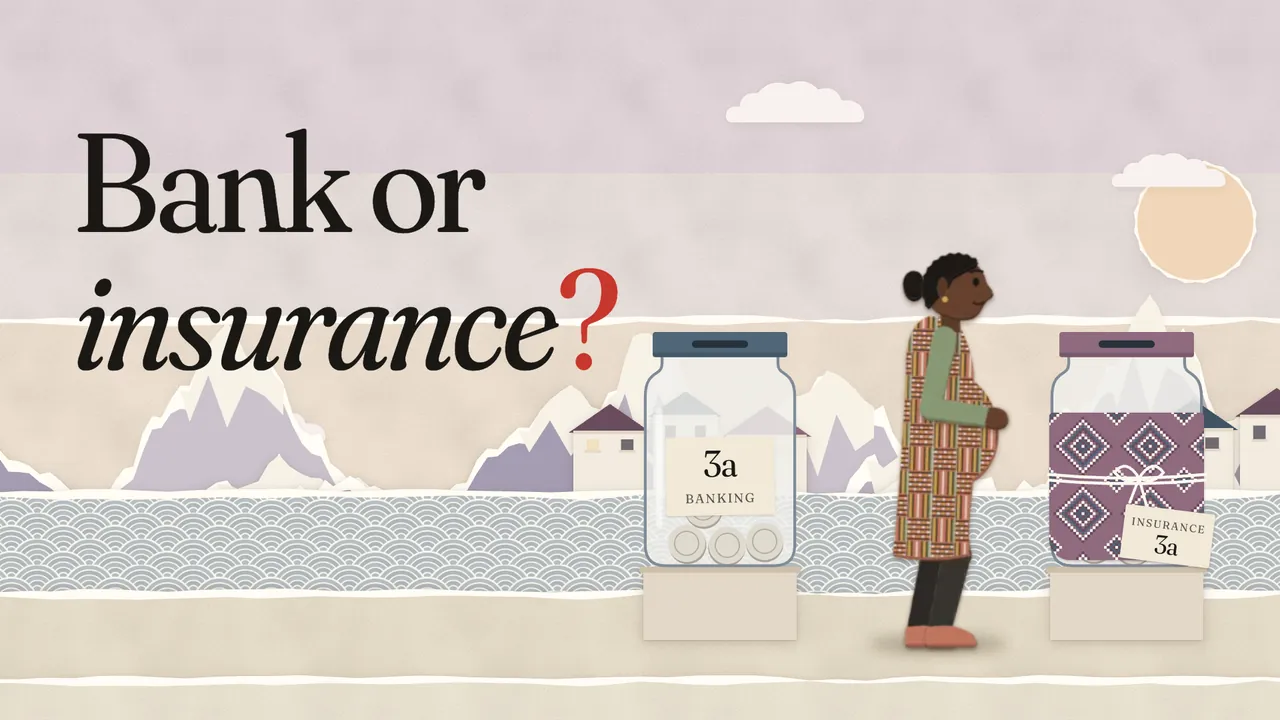
Video · 3:10 Pillar 3a: bank or insurance? What expats should know
Video page, chapters and transcript
Chapters
- 0:00Two different jobs
- 0:34Banking 3a
- 0:54Insurance 3a
- 1:41Who it fits
- 2:07Who it does not fit
- 2:50Your first Swiss insurance review
Read the transcript
0:00 Two different jobs
Pillar 3a: bank or insurance, which is better? As an expat, you can open either, if you earn income in Switzerland that pays AHV contributions. The question is which one fits you. The short answer: they do different jobs. Banking 3a is tax-advantaged saving. Insurance 3a adds cover for the people who depend on your income. For most singles, and couples without children, banking 3a is the cleaner answer.
0:34 Banking 3a
Banking 3a, at an app like VIAC, frankly or finpension, costs about 0 to 0.5% a year. Pay any amount, any year, within the cap, and switch providers without a penalty. But if disability stops your income, your contributions stop.
0:54 Insurance 3a
Insurance 3a costs more: about 1 to 1.5% a year, or more. In return, if disability stops your earning, the insurer keeps paying your contributions. If you die, your beneficiaries get a guaranteed minimum. But the premium is a commitment: once you sign, you pay it. Over 20 years, on a balance that reaches about CHF 500,000, the cost of banking 3a adds up to about CHF 40,000. Insurance 3a: about 125,000. The gap, about 85,000, buys the waiver and the death benefit. Does your household need what it buys?
1:41 Who it fits
Insurance 3a fits a narrow but real situation: a family with debt or dependants. The example on our page: a single-earner family in Zürich, two children. CHF 2,400 a year go into insurance 3a, sized to the gap. The other 4,858 go into banking 3a.
2:07 Who it does not fit
For most singles and couples without children, the answer is banking 3a, plus a small term life policy if there is a mortgage. The insurance 3a sale is rarely the right call there, and we tell clients so. One trap we watch for: these contracts usually run 15 to 30 years. Leave early, and surrender penalties mean you pay back protection you never used. For a stay of 5 to 10 years, the product is wrong by structure. So ask first: who depends on your income? If no one, banking 3a. Look again when a first child or a mortgage arrives.
2:50 Your first Swiss insurance review
If you'd like someone to read your own contracts with you, book your first Swiss insurance review. It's free, 45 minutes, in English, with Robert or Nicole. The link is in the description.
Banking 3a vs insurance 3a, side by side.
Banking 3a
Cost — low
VIAC, frankly, finpension: TER 0.0–0.5% on common ETF allocations. Traditional bank 3a (UBS, ZKB, Raiffeisen): typically higher. No insurer overhead.
Banking 3a
Flexibility — high
Pay any amount any time within the cap. Skip a year, max another. Switch providers freely (one transfer per year, no penalty).
Insurance 3a
Premium waiver — distinctive
If disability stops your earning capacity, the insurer continues your 3a contributions at no cost. Savings flow doesn't break. Material for single-earner households.
Insurance 3a
Death benefit — distinctive
Guaranteed minimum payout to beneficiaries on death — typically the higher of accumulated capital or a fixed amount. Material for dependent-children households.
The decision, in one table.
| Dimension | Banking 3a | Insurance 3a |
|---|---|---|
| Annual cost (effective) | ~0.0–0.5% | ~1.0–1.5%+ |
| Contribution flexibility | Any amount, any year | Contractually committed premium |
| Guaranteed value from day 1 | No — market value | Yes — guaranteed surrender value |
| Premium waiver on disability | No — contributions stop | Yes — insurer keeps contributing |
| Guaranteed death benefit | No — account balance only | Yes — fixed minimum to beneficiaries |
| Expected long-run return | Higher (low fee drag) | Lower (cost of the wrap) |
| Tax deduction (Art. 33 DBG) | Yes — same federal cap | Yes — same federal cap |
| Fits when… | No coverage gap; flexibility matters | Dependents + a real coverage gap |
Both routes share the same federal 3a cap and deduction — the choice is about what the annual cost difference buys, not about the tax treatment.
What the wrap costs over 20 years.
Same contributions, same growth assumptions, balance reaching ~CHF 500,000. The only difference: the effective annual cost of the product. Indicative figures — the point is the shape.
Family protection — where the wrap earns.
Insurance 3a's premium waiver and guaranteed death benefit are real, material features. They earn their cost when there's an actual coverage gap. Three patterns where the gap is real:
- ASingle-earner family with dependent childrenPremium waiver protects the savings flow if disability strikes; death benefit protects dependents from immediate financial cliff. Pillar-2 disability cover often insufficient on a single-earner household. What AHV and the pension fund already pay is worked out in survivors' pensions for a family of four.
- BSelf-employed without robust pillar-2 coverVoluntary BVG affiliations have lower contribution rates; IV pension threshold is harder to meet for self-employed. Insurance 3a's wrap fills the gap that pillar-2 leaves.
- CExisting life-insurance need + 3a tax leverWhere a household needs life insurance anyway (mortgage protection, dependent income replacement), wrapping it inside the 3a tax framework is more efficient than a separate 3a plus term life insurance, bought separately.
One household, both products.
Single-earner family in Zürich, two children, CHF 120,000 income, full 3a cap available. What the review actually decided — figures indicative.
Coverage gap
Assumed pillar 2 covers the family
Single income; BVG survivor + disability cover materially below household need
Real gap — the wrap has a job to doInsurance 3a sizing
All-or-nothing framing
Gap is coverable with a wrapped contract at CHF 2,400/year — premium waiver + guaranteed death benefit
Insurance 3a: CHF 2,400/yrRest of the cap
Unused
CHF 4,858 of the CHF 7,258 cap remains — no reason to pay wrap costs on it
Banking 3a: CHF 4,858/yrTax effect
Unclear
Full cap contributed across both products; ~22% marginal stack in ZH
~CHF 1,597 saved per yearOutcome
Hybrid: CHF 2,400 insurance + CHF 4,858 banking.
Full deduction, protection where it's needed, low fee drag on the rest. The point isn't the products — it's the sizing. Most reviews end exactly here.
Run this for my householdMost clients hold both.
The architecture decision is rarely all-or-nothing. A typical hybrid for a household with one specific coverage gap: insurance 3a sized to cover the gap (e.g., CHF 2,000–3,000/year on a wrapped contract with the right death benefit), banking 3a takes the rest of the annual cap. Both qualify for the federal tax deduction; total contributions stay within the federal cap.
Nicole's review sizes each side to the household's actual situation — coverage gap on one side, cost-efficient retirement accumulation on the other. Most reviews end with a hybrid recommendation, not a single-product pitch.
Our sister brand ThatDay compares the two routes, fees included, in German: Säule 3a: Bank oder Versicherung?
One cap · CHF 7,258 (2026)
Sized to the gap on one side, low fee drag on the other — both inside the same federal deduction.
Which structure fits you?
Decision quiz · 3 questions
Tied or flexible — which structure fits?
Three questions about your situation. The output routes you to the structure that typically fits — pillar 3a (tied, tax-deductible), pillar 3b (flexible, uncapped), or a hybrid of both. Nicole's review confirms the architecture against your specific household.
-
01
Are you planning to leave Switzerland in less than 5 years?
-
02
Do you need flexibility on the contribution amount each year?
-
03
Do you need the tax deduction this year?
Some of the people we've advised
Over 3,500 individual situations, calmly read against the Swiss system — since 2017.

★★★★★
“She assisted and guided me through the entire process of obtaining my Swiss pension refund.”
Ryan K. · Google

★★★★★
“What I appreciated the most is that she was trying to help me solve my problem, not simply sell me an insurance policy.”
Thomas P. · Google

★★★★★
“After several bad experiences with other brokers, working with Mr. Robert Kolar was a completely different experience.”
Dragos H. · Google

★★★★★
“Robert is the best person to partner with if you need to do difficult things such as relocate.”
E. Burke-Murphy · Google
★★★★★
“My session with Robert was one of the most efficient consultation sessions I'd ever had.”
Milad F. · Google

★★★★★
“I was looking to change a supplementary insurance plan, and Robert guided me with professionalism and patience.”
Diana M. · Google

★★★★★
“After returning to Switzerland from abroad, Robert was a tremendous help consulting me about all the changes.”
Steven · Google

★★★★★
“Highly recommend consulting Expat Savvy before making any online insurance comparisons.”
Zendaya B. · Google

★★★★★
“Working with Ben was great. Very prompt and responsive. Would highly recommend to anyone.”
Michele · Google
★★★★★
“Beide arbeiten Hand in Hand und haben die individuellen Anforderungen unserer Kunden immer im Blick.”
Katharina K. · Google
★★★★★
“She assisted and guided me through the entire process of obtaining my Swiss pension refund.”
Ryan K. · Google

★★★★★
“What I appreciated the most is that she was trying to help me solve my problem, not simply sell me an insurance policy.”
Thomas P. · Google

★★★★★
“After several bad experiences with other brokers, working with Mr. Robert Kolar was a completely different experience.”
Dragos H. · Google
★★★★★
“Robert is the best person to partner with if you need to do difficult things such as relocate.”
E. Burke-Murphy · Google

★★★★★
“My session with Robert was one of the most efficient consultation sessions I'd ever had.”
Milad F. · Google

★★★★★
“I was looking to change a supplementary insurance plan, and Robert guided me with professionalism and patience.”
Diana M. · Google
★★★★★
“She assisted and guided me through the entire process of obtaining my Swiss pension refund.”
Ryan K. · Google
★★★★★
“What I appreciated the most is that she was trying to help me solve my problem, not simply sell me an insurance policy.”
Thomas P. · Google
★★★★★
“After several bad experiences with other brokers, working with Mr. Robert Kolar was a completely different experience.”
Dragos H. · Google
★★★★★
“Robert is the best person to partner with if you need to do difficult things such as relocate.”
E. Burke-Murphy · Google
★★★★★
“My session with Robert was one of the most efficient consultation sessions I'd ever had.”
Milad F. · Google
★★★★★
“I was looking to change a supplementary insurance plan, and Robert guided me with professionalism and patience.”
Diana M. · Google
Illustrated portraits — households we've advised on health, pension, and the architecture between them.
Pension architecture with Nicole.
Nicole Bohne
Life insurance, insurance-wrapped 3a, tax optimization · FINMA F01536402
Nicole now handles the booking flow for life-insurance and 3rd-pillar architecture reviews. The call checks whether an insurance wrapper belongs in the plan, whether banking 3a is cleaner, and which tax lever actually fits your household. Written summary within 3 working days.
Book your first Swiss insurance reviewFrequently asked — bank or insurance — pension fit.
What's the difference between banking 3a and insurance 3a?
When does insurance 3a make sense?
When does banking 3a make sense?
Can I have both banking 3a and insurance 3a?
What is the premium waiver in insurance 3a?
What is the guaranteed death benefit in insurance 3a?
What's the cost difference between banking and insurance 3a?
Is the death benefit on insurance 3a worth the higher cost?
How does Nicole help with the bank-vs-insurance decision?
What insurers offer pillar 3a contracts?
Why does Expat Savvy sell insurance 3a but recommend banking 3a sometimes?
How much does the structure review cost?
Pension architecture, read properly.
We've been running pension-architecture reviews since 2017. Banking 3a vs insurance 3a — we say 'banking 3a is the cleaner answer' more often than the market suggests we should, because most households don't have a coverage gap that warrants the insurance-3a wrap. Free, 45 minutes, in English, with Nicole. The disclosure isn't marketing — it's the conversation.
Book your first Swiss insurance review