
How to choose your Swiss health insurance Franchise (deductible).
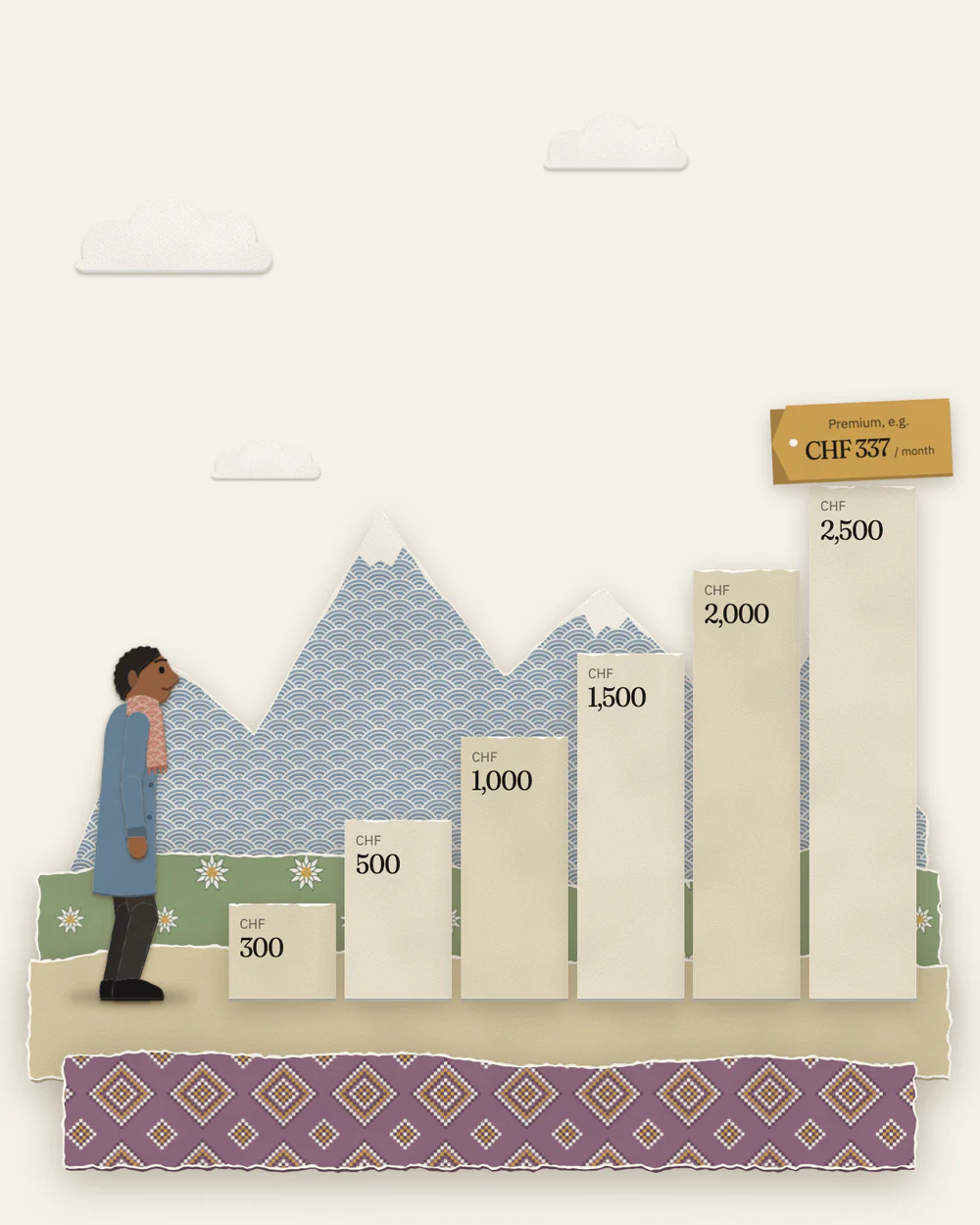
Six federal Franchise tiers under Art. 93 KVV — CHF 300, 500, 1,000, 1,500, 2,000, 2,500 (adults). Plus 10% coinsurance on costs above the Franchise, capped at CHF 700/year. The right tier depends on your actual annual care usage, not your appetite for risk.
Updated
45 minutes with Robert. Free.
In English · With or
We'll send you a short intake form so we understand your needs before we speak.
Your details
You're booked
Check your email for a calendar invite and a video call link.
In brief
The optimal Franchise (deductible) tier depends on your actual yearly medical costs: rare-care households should hold the highest tier (CHF 2,500) for maximum premium discount; regular-care households often net negative on high-Franchise tiers once coinsurance + Franchise stack against the smaller premium discount.
- Adult tiers
- Set by federal law — Art. 93 KVV fixes six: CHF 300, 500, 1,000, 1,500, 2,000, 2,500.
- Coinsurance
- 10% of costs above the Franchise, capped at CHF 700/year.
- Children (under 18)
- Separate tiers of CHF 0, 100, 200, 300, 400, 500, 600, with a CHF 350/year coinsurance cap.
- Premium discount
- Capped by federal law at 70% of the extra risk — up to CHF 1,540/year at CHF 2,500 vs CHF 300.
The math is simple but most people misjudge their own usage band.
One year, one bill — who pays what.
You fall ill, see a doctor, get some tests. The bills add up to CHF 2,000. You pay the first CHF 300 — your Franchise — then 10% of the rest, capped at CHF 700 a year. Your insurer pays the remainder: this year you pay CHF 470.
Pregnancy is the exception: check-ups and the birth come with no Franchise and no 10%.

The Swiss deductible tiers, in one table.
Adult tiers under Art. 93 KVV, with the federally capped premium discount (insurers may reduce the premium by at most 70% of the extra risk you take on) and the worst-case yearly exposure including the 10% coinsurance cap of CHF 700.
| Franchise (adult) | Max. premium discount / year | Worst case out of pocket / year | Tends to fit |
|---|---|---|---|
| CHF 300 | — (baseline) | CHF 1,000 | Regular care, chronic treatment, planned pregnancy |
| CHF 500 | up to CHF 140 | CHF 1,200 | Rarely optimal — discount too small for the added risk |
| CHF 1,000 | up to CHF 490 | CHF 1,700 | Mid-usage households (the in-between tiers rarely win) |
| CHF 1,500 | up to CHF 840 | CHF 2,200 | Mid-usage households |
| CHF 2,000 | up to CHF 1,190 | CHF 2,700 | Rarely optimal — CHF 2,500 usually beats it |
| CHF 2,500 | up to CHF 1,540 | CHF 3,200 | Healthy, rare-care adults with a cash buffer |
| Max. premium discountFranchise10% coinsurance, capped at CHF 700 | |||
Children (under 18): tiers CHF 0–600, coinsurance capped at CHF 350/year. The optimal adult choice is almost always CHF 300 or CHF 2,500 — the middle tiers price the risk poorly.
Franchise selection — step by step.
-
Estimate your annual medical-cost reality
What did you actually spend on healthcare last year? Add up: GP visits, specialist consultations, prescription medications, dental (if separately tracked), planned procedures. For most households the figure lands in one of three bands: rare (under CHF 1,000/year), moderate (CHF 1,000–3,000), regular (over CHF 3,000). Your band determines the optimal Franchise tier.
Tip Include only basic-insurance-relevant care — supplementary-only spend (osteopathy, alternative therapies via EMR/ASCA) is separate. The Franchise applies only to KVG-covered care.
-
Apply the federal discount steps
Federal law caps the premium discount vs the CHF 300 baseline at 70% of the extra risk you take on (Art. 95 KVV). Maximum monthly discounts: CHF 500 = up to −CHF 12/month, CHF 1,000 = up to −CHF 41/month, CHF 1,500 = up to −CHF 70/month, CHF 2,000 = up to −CHF 99/month, CHF 2,500 = up to −CHF 128/month (CHF 140 / 490 / 840 / 1,190 / 1,540 a year). The cap is federal; each insurer sets its own discount at or below it, so check your insurer's figure for your canton.
-
Calculate the break-even cost level
For each Franchise tier, calculate: (annual premium discount vs CHF 300) minus (extra Franchise + 10% coinsurance up to CHF 700 cap). The break-even cost level is where the saving equals the extra exposure. Above that cost level, the high tier nets negative; below, it nets positive.
Tip Use the Franchise calculator on the health insurance hub. Enter your canton, age, model, and projected annual cost; it runs all six tiers and highlights the optimum.
-
Pick the tier matching your usage band
Rare-care (under CHF 1,000/yr): CHF 2,500 tier nets best — maximum discount, low coinsurance exposure. Moderate-care (CHF 1,000–3,000): typically CHF 1,000–1,500 tier. Regular-care (over CHF 3,000): usually CHF 300 tier — the high-tier discounts don't compensate for the larger Franchise + capped coinsurance stack. Don't pick the highest-discount tier reflexively; the math punishes mismatched bands.
-
Review annually as your usage band shifts
Major life events shift the band: pregnancy, chronic-condition diagnosis, ageing into more frequent care, leaving a high-care year. Franchise can be changed at the annual cycle (effective 1 January, notify by 30 November under Art. 7 KVG). Most households should review the band annually rather than setting once and forgetting.
-
Layer the Franchise with model + IPV + insurer
Franchise is one of the four basic-insurance levers. The full architecture also covers: insurance model (Standard / Hausarzt / HMO / Telmed — typically 10–18% premium reduction off Standard), IPV subsidy if eligible (Art. 65 KVG, see IPV guide), and insurer choice (federal benefits identical under Art. 25 KVG; differences in claim-handling and supplementary range). Optimising all four together typically saves CHF 100–300/month vs the default architecture.
What we catch every week.
Trap 01
The highest-Franchise reflex
Households pick CHF 2,500 because it has the biggest discount, without checking actual usage. For regular-care households the math goes negative — Franchise + coinsurance often exceeds the premium saving by CHF 500–1,500/year.
Trap 02
The lowest-Franchise reflex
Households pick CHF 300 'for safety' even with rare care usage. The discount of up to CHF 1,540/year on the highest tier vs the CHF 300 tier outweighs the worst-case Franchise + coinsurance exposure for rare users by a wide margin.
Trap 03
The set-and-forget failure
Households pick a Franchise at registration and never revisit. Pregnancy, chronic diagnosis, lifestyle change shift the band; the Franchise should follow. The annual cycle is for this.
Trap 04
The family-cap miss
Children have separate Franchise tiers (0–600) with a CHF 350/year coinsurance cap. Family planning the household Franchise without modelling the children's tier separately misses material savings on family-cap interaction (Art. 64 §4 KVG).
These four are specific to this topic. The four we check in every review — from the age-curve trap to the 3-month deadline — are in the four traps deep-dive.
A real-pattern case.
Anonymised pattern
A household in Bern with two adults, one in regular physiotherapy + medication for a chronic back condition, the other low-care. Both held the CHF 2,500 Franchise inherited from prior advice. Annual medical spend: ~CHF 4,800 for the high-care adult, ~CHF 600 for the low-care adult.
The math: for the high-care adult, CHF 2,500 Franchise + CHF 230 coinsurance (10% of CHF 2,300 above) = CHF 2,730 out of pocket, against a premium discount of at most CHF 1,540 — net CHF 1,190. At CHF 300 the same year costs CHF 300 + CHF 450 coinsurance = CHF 750. Net cost of holding the high tier: at least ~CHF 440/year.
Recommendation: switch high-care adult to CHF 300, keep low-care adult at CHF 2,500. Annual saving: at least ~CHF 440. The mismatched-band mistake is one of the most common cases we see.
Aggregated from real client patterns. Names anonymised; figures illustrative.
- Medical spend
- ~CHF 4,800
At the CHF 2,500 Franchise
- Franchise
- CHF 2,500
- Coinsurance, 10% of CHF 2,300
- CHF 230
- Out of pocket
- CHF 2,730
- Premium discount, at most
- −CHF 1,540
- Net
- CHF 1,190
At the CHF 300 Franchise
- Franchise
- CHF 300
- Coinsurance
- CHF 450
- Net
- CHF 750
Net cost of holding the high tier at least ~CHF 440/year.

Beyond this guide — the 45-minute review.
The 45-minute review with Robert runs the Franchise math against your actual prior-year medical spend, models the five-year cost path under different Franchise selections, and checks the family-Franchise cap for households with children.
In the worked example above, one Franchise change saves at least CHF 440 a year — a smaller change than switching insurer, and no underwriting risk.
Robert Kolar
Insurance advisor — health insurance specialist
20+ years in Swiss insurance. Reads the basic and supplementary contract for every review. The 45-minute review covers the four-lever framework applied to your address, age, household and existing coverage. German, English, Czech.
Common mistakes.
Picking the highest discount reflexively
CHF 2,500 makes sense for rare-care households. For regular-care, the math goes negative.
Picking CHF 300 'for safety'
If your usage genuinely lands under CHF 1,000/year, the high-tier discount outweighs the worst-case exposure substantially.
Set-and-forget
Annual review against last year's actual spend is the discipline. Major life events shift the band.
Ignoring children's separate tiers
Family-Franchise cap (Art. 64 §4 KVG) interacts with children's tiers. Model children separately.
Confusing Franchise with model
Franchise is one lever; insurance model (Standard/Hausarzt/HMO/Telmed) is a separate lever. They compound; don't substitute one for the other.
Frequently asked — choose your Franchise (deductible).
What is the Franchise in Swiss health insurance?
What's the best Franchise for Swiss health insurance?
Can I change my Franchise mid-year?
How much do I save by raising my Franchise?
What is the 10% coinsurance?
Should children have a Franchise?
Is the Franchise tax-deductible?
What if I exceed my Franchise mid-year?
Franchise selection, read properly.
We've been running Franchise math for expat households since 2017. The actual-usage band, the federal discount steps, the family-cap interaction, the model + Franchise stack. Free, 45 minutes, in English, with Robert. In the worked example above, fixing a mismatched Franchise saves at least CHF 440 a year — with no underwriting risk.
Book your first Swiss insurance review