
3rd pillar & tax
Swiss 3rd pillar vs life insurance — when each fits.
3a builds tax-advantaged retirement capital. Life insurance pays your dependents. The hybrid wraps both — when it fits, when it doesn't. An advisor's read.

Key takeaways
- 3a is a tax-advantaged savings vehicle. Life insurance is a death-benefit product for people who depend on your income. They're different jobs — most expats don't need both, some need one, some need a combination.
- Insurance-wrapped 3a (Säule 3a gebunden) bundles savings + premium-waiver + death benefit into one product. It fits a narrow but real situation: family with debt or dependents, where the savings discipline + protection combination is the right shape.
- For the average single or DINK expat: 3a only, plus a small term life policy if there's mortgage debt. Our bank-vs-insurance 3a comparison takes the numbers further. The insurance-wrapped 3a sale is rarely the right call here — and we tell clients so.
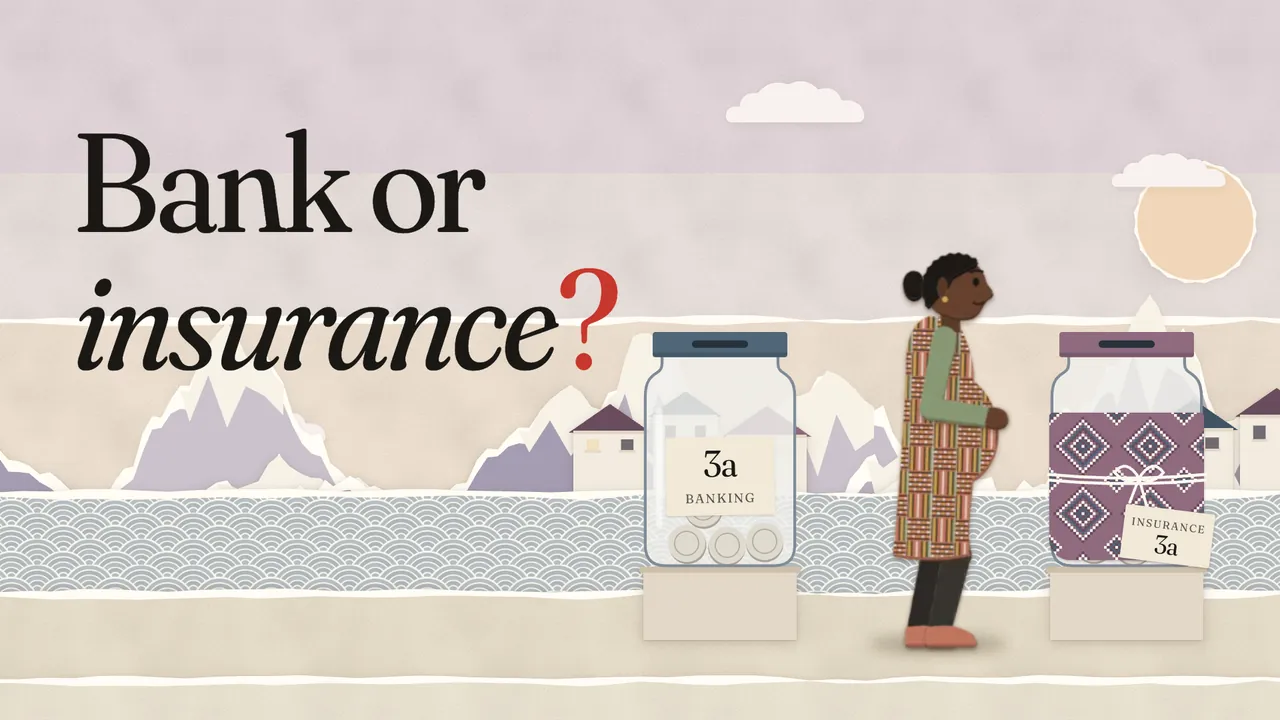
Video · 3:10 Pillar 3a: bank or insurance? What expats should know
Video page, chapters and transcript
Chapters
- 0:00Two different jobs
- 0:34Banking 3a
- 0:54Insurance 3a
- 1:41Who it fits
- 2:07Who it does not fit
- 2:50Your first Swiss insurance review
Read the transcript
0:00 Two different jobs
Pillar 3a: bank or insurance, which is better? As an expat, you can open either, if you earn income in Switzerland that pays AHV contributions. The question is which one fits you. The short answer: they do different jobs. Banking 3a is tax-advantaged saving. Insurance 3a adds cover for the people who depend on your income. For most singles, and couples without children, banking 3a is the cleaner answer.
0:34 Banking 3a
Banking 3a, at an app like VIAC, frankly or finpension, costs about 0 to 0.5% a year. Pay any amount, any year, within the cap, and switch providers without a penalty. But if disability stops your income, your contributions stop.
0:54 Insurance 3a
Insurance 3a costs more: about 1 to 1.5% a year, or more. In return, if disability stops your earning, the insurer keeps paying your contributions. If you die, your beneficiaries get a guaranteed minimum. But the premium is a commitment: once you sign, you pay it. Over 20 years, on a balance that reaches about CHF 500,000, the cost of banking 3a adds up to about CHF 40,000. Insurance 3a: about 125,000. The gap, about 85,000, buys the waiver and the death benefit. Does your household need what it buys?
1:41 Who it fits
Insurance 3a fits a narrow but real situation: a family with debt or dependants. The example on our page: a single-earner family in Zürich, two children. CHF 2,400 a year go into insurance 3a, sized to the gap. The other 4,858 go into banking 3a.
2:07 Who it does not fit
For most singles and couples without children, the answer is banking 3a, plus a small term life policy if there is a mortgage. The insurance 3a sale is rarely the right call there, and we tell clients so. One trap we watch for: these contracts usually run 15 to 30 years. Leave early, and surrender penalties mean you pay back protection you never used. For a stay of 5 to 10 years, the product is wrong by structure. So ask first: who depends on your income? If no one, banking 3a. Look again when a first child or a mortgage arrives.
2:50 Your first Swiss insurance review
If you'd like someone to read your own contracts with you, book your first Swiss insurance review. It's free, 45 minutes, in English, with Robert or Nicole. The link is in the description.
Looking for life insurance itself — term cover, what it costs, whether you need it at all? That is our guide to life insurance in Switzerland. This post is about how it relates to pillar 3a.
Most expats arrive in Switzerland and get pitched both products in their first year. The bank suggests a 3a account at maximum contribution. The relocation contact’s “financial planner friend” suggests a life insurance policy that “also saves for retirement.” Both pitches are technically right and editorially incomplete. 3a and life insurance do different jobs — and there’s a third product that bundles them, fits some expats well, and is over-sold to most others. This post walks through which is which.
What each product actually does.
Säule 3a is a savings vehicle with tax advantages. You contribute, the contribution is deducted from your taxable income up to CHF 7,258 per year for an employed person with a 2nd pillar (or up to CHF 36,288 for self-employed without one), the balance grows in your name, you withdraw at retirement at a preferential cantonal rate. There is no death benefit beyond your accumulated balance. There is no disability protection beyond your accumulated balance. It’s a wrapper around your savings — a very efficient one, but a savings wrapper.
Life insurance is a protection product. You pay an annual premium during a defined policy term; if you die during the term, the insurer pays a death benefit to your designated beneficiaries — typically anywhere from CHF 100,000 to CHF 2,000,000 depending on the policy and your underwriting. There is no savings component on a pure-term policy. The premium is largely consumed in the year it’s paid (it’s the cost of the death-benefit risk transfer). Term life insurance is the cheapest, most efficient form of protection and the right answer for most expats who need any cover at all.
Insurance-wrapped 3a — Säule 3a gebunden — is the third product. A Swiss life insurer issues a 3a contract that includes a savings component, a death-benefit component, and a disability-waiver component (Prämienbefreiung bei Erwerbsunfähigkeit). The whole annual premium is 3a-deductible up to the cap, but a portion of it funds the embedded protection rather than savings. It bundles two jobs into one product. For some expats this is the right shape. For most it’s the wrong shape.
Three Swiss financial products, three different jobs, 2026.
| Product | Primary purpose | Tax deduction | Built-in protection | Typical effective cost | When it fits |
|---|---|---|---|---|---|
| Säule 3a (digital / bank) | Tax-advantaged savings | ◆ Up to CHF 7,258/yr | None | 0.39–0.65% TER | Most expats — anyone with taxable income in Switzerland |
| Term life insurance | Death-benefit protection | None on premium itself | ◆ Death benefit to beneficiaries | ~CHF 200–800/yr per CHF 500k cover (age-dependent) | Expats with dependents and/or mortgage debt |
| Säule 3a gebunden (insurance-wrapped 3a) | Savings + protection bundle | ◆ Up to CHF 7,258/yr | ◆ Death benefit + premium waiver on disability | 1.5–3.5% effective cost | Families needing the bundled discipline + protection combination |
The question that determines which row applies isn’t a tax question. It’s a dependents-and-debt question. The tax mechanism is similar across the first and third rows; the cost structure and the protection content are very different.
Quick check
Want us to map which of these three actually fits your situation?
The dependents-and-debt question.
Before any product decision: who depends on your income, and what debt would they carry if you died tomorrow?
If you’re single with no children, no partner financially dependent on your income, and no mortgage — the pure-protection answer is none. You don’t need life insurance. The Swiss state and your BVG already cover the modest residual obligations. Your money goes into 3a (and ideally 2nd-pillar buyback) as a pure savings exercise. This is the modal expat profile in their first 5 years in Switzerland.
If you have a partner who couldn’t easily replace your share of household income, or a child, or a mortgage where the surviving partner would struggle — there’s a real protection need. The default shape is term life insurance covering 5–10× annual income, or the outstanding mortgage balance, whichever is larger. Pure term, defined term length matching the dependency window (until kids are independent, until mortgage is paid down), no savings component bolted on. This is where life insurance earns its place — and where the cheapest form of it (term, not whole life) is almost always the right form. The term-cover decision itself — need, sizing, cost, which insurers offer it — lives on our life-insurance page.
If you have all of the above plus a desire to save discipline-driven inside one product instead of two — and the savings + protection bundle fits both your tax bracket and your protection profile — then insurance-wrapped 3a (Säule 3a gebunden) becomes worth considering. This is genuinely a smaller subset than the products are sold to. The pitch is “two birds, one stone.” The honest read is “one stone, slightly heavier than two separate stones, with embedded discipline that some clients value and others don’t.”
When insurance-wrapped 3a actually fits.
This is the product category we genuinely sell — but only when the contract matches the household. Nicole reviews insurance-wrapped 3a contracts against the protection need first, then the tax case, then the insurer. We are not anti-product. We are anti-mismatch. The four scenarios where insurance-wrapped 3a is the right call:
-
Family with mortgage debt and savings inertia.
Mid-career couple with a CHF 800k mortgage, two children, and a confessed inability to maintain savings discipline outside an automated structure. Insurance-wrapped 3a forces the discipline (premium is mandatory once the contract is signed), funds the death-benefit cover that the mortgage requires, and the disability waiver protects the savings if income is lost. Three jobs in one product, all of which would otherwise need separate decisions.
-
Self-employed with thin BVG cover.
Self-employed expats often have minimal or no Pensionskasse, which means minimal employer-paid disability and death cover. Insurance-wrapped 3a fills the protection gap inside the tax-deductible wrapper. A separate term life + digital 3a achieves a similar outcome with lower fees, but only if the client will actually maintain both — which is a real if for some self-employed clients.
-
High-income expat with a specific death-benefit gap.
BVG death benefits are typically 1–4× annual salary; for very high earners the multiple is capped and the gap to actual income-replacement need is meaningful. Insurance-wrapped 3a closes part of the gap inside the 3a tax shelter, with the disability waiver as the additional protection layer. Whether to use insurance-wrapped 3a vs separate term life vs both depends on the specific gap size and the marginal-tax math.
-
Long-term resident planning to retire in Switzerland.
Insurance-wrapped 3a contracts are typically long-duration (15–30 years) with surrender penalties for early termination. They fit clients who plan to hold to maturity. For mobile expats with a 5–10-year horizon, the surrender penalties make the product wrong by structure — independent of any pricing argument.
When 3a alone is the right answer.
For the modal expat profile we see — single, DINK, or family with adequate BVG cover and no mortgage — the right structure is digital 3a only, plus a small separate term life policy if there’s a specific protection gap. The reason isn’t fee minimisation; it’s matching the product to the actual job. A pure savings wrapper does the savings job most efficiently. A pure protection product does the protection job most efficiently. Bundling adds cost without adding capability for clients who don’t need the bundle.
We tell this to many expats who arrive expecting a life-insurance pitch because someone else already pitched them. They leave with: “max 3a, do the BVG buyback, skip the life insurance for now — revisit when the mortgage closes or the first child arrives.” That’s the honest read. It’s also the conversation that protects the next decade of their savings from a product that didn’t fit.
The four traps in 3a vs life insurance decisions.
These traps map directly to the 3a-vs-life-insurance question. The age-curve trap shows up as buying term life at 32 with a 30-year term — the premium is locked at the young rate, but renewal at 62 is brutal. Better to apply for the term covering the actual dependency window (15–20 years often), not a default 30. The three-month deadline parallels the year-end 3a contribution window (31 December for the current tax year) and the annual life-insurance underwriting cycle — both have specific deadlines that the apps don’t enforce. Coverage that pays vs coverage that fights is the surrender-penalty reality of insurance-wrapped 3a — clients who exit early on a contract that didn’t fit pay back the protection they never used. And matching coverage to your life is the dependents-and-debt question itself: the right product depends on who would suffer financially if you died, not on what the planner is licensed to sell.
How the maths usually settles.
For the modal single or DINK expat in their first 10 years: maximise 3a in a low-cost vehicle, do the BVG buyback if there’s room, skip life insurance until there’s a real dependent. Total annual outlay: the 3a contribution. Total protection: BVG (employer’s death benefit, typically 1–4× salary) plus AHV survivor benefits.
For the family-with-mortgage profile: maximise 3a, plus a term life policy sized to the mortgage balance with a term matching the mortgage duration, plus disability cover (often through BVG or as a standalone product). Total annual outlay: 3a contribution + a few hundred francs of term life premium. Total protection: BVG + the term policy + the 3a savings building over time. This is the “two stones” approach.
For the family-with-savings-inertia profile: insurance-wrapped 3a as the consolidated vehicle, with the bundled death benefit, disability waiver, and savings discipline. The fee load is higher, the structure is more rigid, and the discipline is the feature that makes the higher cost worth it. Total annual outlay: the wrapped-3a premium. Total protection: bundled inside the contract.
The wrong answer in each case is the same: buying the product that doesn’t match the profile because it was the product being pitched. The right answer is matching the product to the dependents-and-debt question first, the savings architecture second, and the specific provider or contract third.
The honest answer.
Most expats don’t need life insurance, and the insurance-wrapped 3a sale is rarely the right call for the modal single or DINK profile we see. For the families who do need protection — mortgage, children, dependent partner — the cleanest structure is usually digital 3a + a small separate term life policy. For the narrower set of families where bundled discipline and protection match the situation, insurance-wrapped 3a (Säule 3a gebunden) is a real product that does a real job.
The conversation worth having isn’t “3a vs life insurance” as a head-to-head. It’s “which combination of these three products matches my dependents-and-debt profile, my BVG cover, my retirement timeline, and my cross-border plans.” That’s the conversation Nicole has with expat clients now: specific, careful, and often smaller than the product portfolio the client expected — which is the brand position we’re built around.
Frequently asked.
What's the difference between 3rd pillar and life insurance?
What is insurance-wrapped 3a (Säule 3a gebunden)?
Is insurance-wrapped 3a worth it?
How does 3a withdrawal taxation work?
How are life insurance death benefits taxed in Switzerland?
Should I buy life insurance through my employer or privately?
Can I use a 3a contribution to fund a life insurance premium?
By the team